|
Many
Ways
Lead To Rome
So
your active system could well be a 2-way system with one or two 7, 8,
or 10 inch woofer/midrange unit(s) plus a tweeter. The determination
of the crossover frequency depends on the capabilities of the chosen
tweeter (linearity and power handling) as well as the technical specifications
of the low-mid unit and especially the linearity of the frequency curve.
In this way you will avoid all the pitfalls which present themselves
when constructing a three-way system with three amplifiers and three
different units for low, mid and high frequencies.
The
choice of units for an active 2-way system can be inspired by existing
DIY sets or projects that do not use complicated filters but serial
filters or simple sections with 12 or 6 dB slopes or combinations.
If
an existing DIY design from a shop is chosen as a basis of your active
system, see to it that the volume for the woofer/low-mid range unit
is recalculated as you leave out the passive filter section with the
coil in series. The internal volume should be less.
|
|
|
Many
high fidelity enthusiasts stick to the classic configuration of
two satellites and one (or if the budget and the room allows)
two sub woofers. Especially analog fanatics go by this configuration
to which extra speakers can be added and used when viewing movies.
|
|
|
|
In
all cases the main speakers can consist of various transducers
in appropriate cabinets.
|
|
|
Simple
Solution
If
you want to go active by just adding a subwoofer to a pair of satellite
speakers, you can start by using existing 2-way systems and combine
these with just one subwoofer, home built or manufactured commercially.
This is the most common configuration. There are many options.
 Not
every sub woofer sounds the same. The best options are the closed
box systems, and the front loaded (band pass) systems. The Janis
subwoofer is in principle such a band pass system. Not
every sub woofer sounds the same. The best options are the closed
box systems, and the front loaded (band pass) systems. The Janis
subwoofer is in principle such a band pass system.
The
advantage of the band pass system is that it sounds like a closed box
system with a continuously decreasing excursion. These systems do need
woofers with strong magnets and these are of course expensive.
That is why so many designers use the cheaper units in bass reflex systems.
The
disadvantage of bass reflex (ported) enclosures is that they
have an irregular excursion curve with a dip in the 60 to 80
Hz. region. There the excursion is minimal and in fact not logical.
Back
loaded horns do not go deep and if you want to reproduce low
frequencies through a horn, the mouth of the horn should be extremely
large and the way the sound travels has to be rather long. Even if your
listening room in your house permits, these horns can occupy the entire
back wall of the listening room.
Transmission
line systems suffer from the same phase shift as bass reflex systems.
And again the cone excursion is restricted in that area. There the sound
is slender if compared to a big unit in a closed box. In many transmission
lines the lowest frequencies are emphasized and are slow.
There
are also designs for open baffles. But the side panels have to
be very large (as in the case of the horns). And there are various dipole
designs too.
Each
and every box, baffle, column or screen has to reproduce sounds
which in real life are produced by large instruments (organ, longest
and thick strings of the grand piano, big drum, large orchestra), or
by instruments with a entirely different shape (violin, cello, flute,
etc.), it certainly is no mean task to get a loudspeaker system "right".
In this context the question that is often repeated is: Can a large
electostatic loudspeaker reproduce a violin sound?
CHOOSE
ANOTHER SUBJECT
To
Boost Or Not To Boost
Many hobbyists
and audiophiles use 24 dB Linkwitz filters to separate the woofer
completely from the transducers for the mid and high frequencies. It
is up to you if you want to opt for such steep filter slopes. It may
be that when gaining more experience while assembling an active system
you will find out that less steep slopes may result in better phase
and a more harmonic and lively sound.
Also you
are free to use electronics that help you correct the frequency curve
of the unit in the subwoofer enclosure, and can boost the lowest frequencies
as some designers do propagate. This is however a method which I personally
do not like at all. Better is to give the unit its appropriate volume
and curve, as the parameters enable you to calculate.
Also Motional
Feedback circuits do hamper transient response. The correction generated
by the feed back takes the tops of the pulses of the woofer and other
reproducers that are corrected this way. And as the lows are the basis
on which the harmonics of the entire system are build, naturally the
feedback correction can be heard in the rest of the frequency band,
can be heard in the total sound picture. The reproduction may sound
clean, but has a less realistic character.
CHOOSE
ANOTHER SUBJECT
Bass
Enclosures

The
Boffle
An ingenious
solution which gives a strong and well controlled bass reproduction
is that of The Boffle which was designed by H.A. Hartley. I read the
discription of The Boffle in one of the old 1950s issues of The Gramophone.
The author of the article promised high quality sound.
Hartley
said about it: "I suppose I am an old-fogey purist, but it does
seem to me that as a speaker in its enclosure has to make an attempt
to reproduce every kind of musical noise, it must have no "personality"
of its own. It must be absolutely unbiased; it must add nothing and
take nothing away."
And that
is exactly what The Boffle can do. Of course the music making depends
on what unit you choose.
The Boffle
is in fact a cube with an edge of say 50 or 60 cm. My version had a
Philips dual cone loudspeaker unit in it. It was a full range unit with
a stiff suspension (corrugated surround). There was no separate high
frequency unit connected to this speaker. So no extra reproducer for
the highs, connected with a capacitor in series. In olden days full
range units were often used and were a pleasure to listen to as there
was no phase shift (which means no time delay) as was often experienced
in 2 or 3-way systems if the design of the filter and the position of
the units on the baffle were not correct. Being used as a teen ager
to my boffle, I was not pleased when I heard a 2-way or 3-way system
even from a renown manufacturer.
Any speaker
system which uses a full range driver will give you insight of what
coherent sound is. Open baffles are more appropriate for mid range reproduction
and for a woofer/subwoofer The Boffle is a very good choice.
The Boffle
as seen below was drawn from memory by me. The compartments are separated
by sheets or panels of 5 mm felt. The original plan stressed that the
holes in the felt should vary the way the drawing shows. The holes directly
behind the unit should be large in order not to obstruct the flow of
air. Also a too small hole at a is not advised. The second
half of the boffle (between a and back panel b)
also has variations to work correctly. This how I built The Boffle and
never adjusted the holes of one or more of the panels.
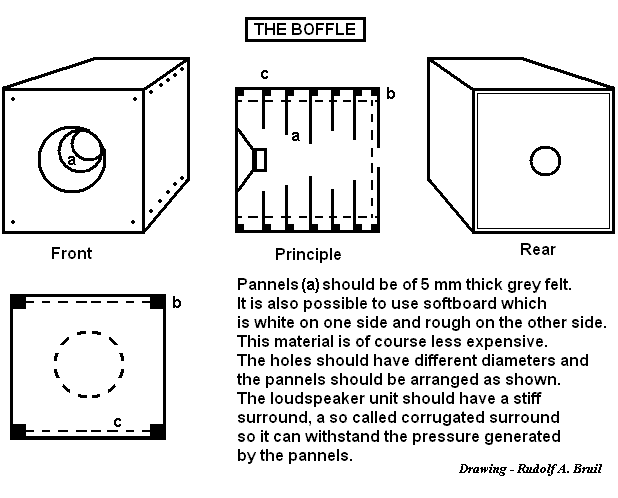
The Hartley
Boffle uses felt panels. Felt was not readily available at the time
and had to be ordered. It was also expensive. So in my system I used
sheets of soft board. That was practical because the holes could easily
be cut out and the panels could be replaced if necessary. On top of
that they were easily fixed to the wooden bars. Knowing from years of
experience what damping materials do and how to apply them, I suspect
that soft board which is a "harder", less absorbent material,
gave a very good low mid register, especially the sound of the grand
piano had tangeability.
I saw a drawing on the internet of a boffle without the hole in the
back panel. And there was also a drawing of a cabinet which was called
Boffle by the owner of the web page but was in fact an "ordinary"
loudspeaker enclosure.
 Richard
Schmetterer, President of Hartley Loudspeakers, Inc. in Wilmington,
North Carolina writes on April 17, 2013:
Richard
Schmetterer, President of Hartley Loudspeakers, Inc. in Wilmington,
North Carolina writes on April 17, 2013:
"The Boffle was patented by Hartley Turner Radio LTD. of England.
This company became the Hartley Co. Ltd of England and now Hartley
Loudspeakers, Inc. in the US. The Boffle design was done by Philip
Keston Turner (P.K. Turner) and the patent was granted in 1935."
See:
A History of
Hartley Loudspeakers
Quality
 A
high level of quality can be achieved when using commercially manufactured
3-way systems connected to an active crossover filter. The better quality
is specifically attained with satellite three-way systems which are
equipped with rather large woofers, preferably 12" or 10"
woofers in parallel, and placed vertically in the enclosue or mounted
in individual enclosures that are stacked and if you have a large listening
room you can place them horizontally. A
high level of quality can be achieved when using commercially manufactured
3-way systems connected to an active crossover filter. The better quality
is specifically attained with satellite three-way systems which are
equipped with rather large woofers, preferably 12" or 10"
woofers in parallel, and placed vertically in the enclosue or mounted
in individual enclosures that are stacked and if you have a large listening
room you can place them horizontally.
I have
discovered that large woofers for the lower mid section do follow
up the frequency band of the subwoofer in a much better way than
small sized units do. Large woofers provide a far more realistic sound.
The choice
of crossover frequency will generally be around 100 Hz. Such a system
can later be updated by adding a second subwoofer.
Although it is said that frequencies under 150 Hz. are non-directional,
it does matter whether one or two subwoofers are being used.
Another
option is to go active with the small satellite 2-way systems and omit
the specific subwoofer, but combine 2-way satellites with large woofers
as in a full blooded 3 way system. These woofers have to have their
appropriate (well calculated) cabinets, one for the left and one for
the right channel. The satellite 2-way systems can be home built and
optimized in relation to the woofer. The appropriate turnover-frequency
should be determined in practice but could be situated in the region
from 350 to 600 Hz.. Such a system has the advantage that it leaves
at least three octaves of the fundamentals intact.
Classic
3-Way
The most
original and most difficult option for assembling/constructing an active
loudspeaker system is not to use existing 2- or 3-way satellites with
subwoofers, but to calculate and build the cabinets for the low, the
mid and the high frequency bands oneself.
Whether
the choice is for incorporating a subwoofer or not, the midrange units
must have the ability to perform well up to round and about 3000 or
4000 Hz. As said earlier, a very musical system can consist of a 12"
woofer, one 5" or 7" midrange unit and a quality unit for
the high frequencies. Crossover frequencies could be 600 and 3000 Hz.
in case of a dome-tweeter or horn loaded ribbon tweeter. In the event
a ring radiator like one manufactured by Fostex is chosen, the crossover
frequency for the treble should be 7000 Hz. With such a system a very
harmonious and lifelike reproduction can be achieved especially if you
choose high efficiency units. That is the classic way.
There are
many options and many possibilities and also many pitfalls. But you
can begin by adding a subwoofer and crossover to an existing system.
And that can give you already increased listening pleasure, a lot of
fun and it is a learning school for gaining knowledge. After some time
you can continue from there and expand your active system. Or not. It
is up to you.
Complicated
It takes
a lot of calculation and experimentation to find the best units for
a three way system with crossover frequencies of 100 Hz. and, say, 4000
Hz. as the mid band speaker should well be able to reproduce the most
important section of 100 to 200 Hz. as well as the higher frequencies.
You
see: the possibilities are many. The question remains: What is a
good option?
Whatever configuration is opted for: the quality of the final result
depends on your own experience and expertise which you will gain
in practice.
Do
not think that you will be ready in a couple of months. An active
system is not easily built. To give more insight in the matter the
following topics will be considered:
1. Subwoofer and the Electronic Crossover Module
2. Amplifiers, Loudspeaker Cable and Interconnects
3. Woofer, Low-Mid Loudspeaker Unit and High Frequency Unit.
|




 Subwoofers
have existed since the early days of high fidelity. Even before World
War II (according to Jean Hiraga in his excellent book 'Les hautparleurs'
- Editions Fréquences. Paris, 1980) a man named Olney proposed
a loudspeaker specifically designed for the reproduction of the low
frequencies. Mr. Olney used a labyrinth (which was later tapered by
Dr. Baily and became known as the 'transmission line' loudspeaker).
Subwoofers
have existed since the early days of high fidelity. Even before World
War II (according to Jean Hiraga in his excellent book 'Les hautparleurs'
- Editions Fréquences. Paris, 1980) a man named Olney proposed
a loudspeaker specifically designed for the reproduction of the low
frequencies. Mr. Olney used a labyrinth (which was later tapered by
Dr. Baily and became known as the 'transmission line' loudspeaker).


 that he made some 50 cabinets before he arrived at the
excellent sonic performance of his system which has a flat frequency
response from 30 to 100 Hz. (-3dB).
that he made some 50 cabinets before he arrived at the
excellent sonic performance of his system which has a flat frequency
response from 30 to 100 Hz. (-3dB).  current
and are soon exhausted because they need to deliver current directly
out of the AC mains.
current
and are soon exhausted because they need to deliver current directly
out of the AC mains. 

 sound
produced by expensive Avalon loudspeakers (and other high-end loudspeaker
systems) in various living rooms because the electronics of the expensive
subwoofer(s) did not have the continuous variable phase control. Disconnecting
the subwoofer brought back the harmonious sound and the slam of the
Avalons. Even today, many years after my conversation, these subwoofers
still do not have the variable phase control but just a phase switch.
sound
produced by expensive Avalon loudspeakers (and other high-end loudspeaker
systems) in various living rooms because the electronics of the expensive
subwoofer(s) did not have the continuous variable phase control. Disconnecting
the subwoofer brought back the harmonious sound and the slam of the
Avalons. Even today, many years after my conversation, these subwoofers
still do not have the variable phase control but just a phase switch.


