SOUND FOUNTAIN

hobbyists's views for hobbyists
Digital Audio Compact Disc History


25 Years CD: August 17, 1982 - August 17, 2007


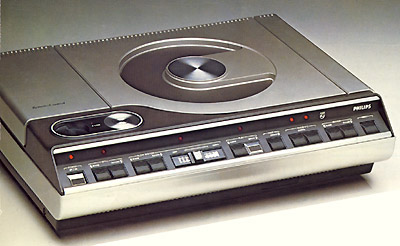
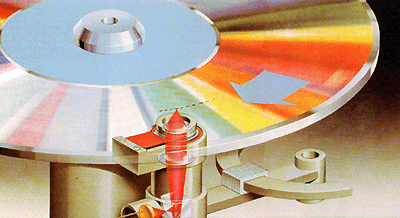
Edited image. Oiginal image taken from the brochure issued by Philips in 1981 at the Festival du Son in Paris. The added schematic diagram indicates the functioning of the laser pick up, the conversion, and the amplification of the signal.

When the engineers in the world famous Philips Physics Laboratory start working on the laser video disc around 1967, they will combine images and sound. That brings about the idea of making a laser disc just for music and speech with no images added. The final outcome is a disc of 12 cm in diameter which is read by a laser beam. The disc has a reflective layer, covered by a non reflective layer with holes of various lengths which measure mere micrometers. These holes represent the recorded music. Only when the laser beam is reflected by the disc, the beam is read by a photo cell and the data which it represents is converted to an analog signal.
Although the resolution of the signal and the depth of the sound are very low in quality, relative to the analog tape and LP, this disc is to be the modern substitute for the vinyl long playing stereo gramophone record.
The first Compact Disc, as the disc is called, is pressed on August 17th, 1982, in the Polygram pressing plant near Hannover, Germany.
The CD is 25 years old.

Sound Premonition
In the late nineteen seventies digitally recorded sound is being demonstrated at the big audio fairs: Funk- Ausstellung (Berlin), CES (Chicago and Las Vegas), Heathrow (London), Firato (Amsterdam), Festival du Son (Paris), etc.
Many discriminating music lovers and audiophiles are not too enthusiastic about digital sound. For many it is not difficult to hear that the resolution of the high frequencies is extremely low and that the bandwidth is restricted. This is the more apparent if the exhibitor in the next stand plays music coming from an analog source.

Analog Sophistication
By the end of the nineteen seventies designers of high end amplifiers are concerned about an extreme large bandwidth, they are investigating all sorts of distortions in order to further improve the reproduction. Not just the values of the Total Harmonic Distortion (THD) and how to handle these, but also the newly discovered Transient Intermodulation Distortion (TIM) and Dynamic Intermodulation Distortion (DIM). Digital formats will make all further research for improvements in these fields practically obsolete.

Digital Fear
Many do fear the arrival of a digital format with such a low resolution. Especially those who have invested in high end turntables, expensive cartridges, in tape recorders with professional qualities, in esoteric amplifiers and grandiose loudspeakers. They have brought the reproduction of the analog Stereo Lp to an extremely high and refined standard and are enjoying pure music, reproduced from records pressed from high grade vinyl with silent surfaces.
Are the fears justified?


"This day will be a memorable day in the history of sound. For the first time music will sound in the living room as pure as in the concert hall: without the extra noise of the needle in the groove, without dust particles, scratches or dents."

These are the first lines of an advertisement introducing the CD to the music loving public. The advertisement appears in Dutch newspapers on the 1st of March, 1983. The first CD was pressed on August 17 1982 in the Philips factory in Hannover, Germany, and was introduced in Japan on November 1, 1982.

Successor to the Stereo Lp
Thomas Alva Edison is the inventor of the Phonograph and the vertical engraving of the signal on a cylinder. It is the so called hill and dale technique which is later used in a disc proposed by Edison himself and by Pathé in France.
Emile Berliner proposes the horizontal, meandering groove. Edison's hill-and-dale is soon outmoded. But it comes in handy when the stereo long playing record is designed and officially is introduced in 1958.
After the launching of the stereo Lp, manufacturers of consumer electronics and a few record companies start thinking about the next step of improvement. Some start thinking of a completely new recording system, a new sound carrier.

The Beginning
In 1966 audio journalist Leonard Marcus of High Fidelity Magazine investigates the future of recording in a very interesting article called 'The Prospects in Audio'. He writes that CBS Laboratories are developing a new analog disc. It is Dr. Goldmark himself who demonstrates this new format. It is a 7 inch record with an extremely fine groove. It turns at 8 RPM and can contain the same amount of information as a 12" Lp. It shows that CBS is a firm believer in their own invention: the analog long playing record.

RCA
In that same article in the April 1966 issue of High Fidelity Magazine, RCA's Dr. Harold Olson tells the readers that the record of the future will be completely different: ''There will be no music on it, only a binary code''. He adds that only a very small disc will be necessary. The way the code will be read is also completely different. No needle or other mechanical devise will be used. Olson: ''The record could be read by an electron beam.'' It will be possible to record half an hour of music on a disc as small as the size of a quarter dollar (according to Wikipedia the quarter dollar measures 0.955 inches = 24.26 mm in diameter).
The carrier is not necessarily a disc. The encoded information can be printed on a metal bar, or a piece of paper, or whatever object. In 1966 this means an upcoming revolution. It is the dawning of the age of the computer.
Futuristic
In the April 1966 issue of High Fidelity, pianist Glenn Gould writes an essay on ''The prospects of Recording''. He goes even further and predicts that the listener will have a console with a keyboard in his listening room. After typing the title of the work he wishes to hear, say Beethoven's Emperor Concerto, he can choose from a list of available recordings. After entering the selected performance, the music signal will be sent by cable to his hi-fi set and a small sum will be deducted from his bank account.
The prediction is that it will also be possible to store the entire performance in a chip (today that would be a memory stick , or a memory card) which can be bought in the "record shop".

Ampex
Tape recorder manufacturer AMPEX is experimenting with a digital tape format. Although IBM is computing with big machines using reel to reel tape recorders and connecting their clever Selectric typewriters for printing the data sheets, designing a digital tape recorder for sound is a complicated affair. The marketing of such a recorder is impossible as the cost is $150.000 per unit.

Bell Laboratories
Bell Laboratories are concentrating on the idea of the Vocoder. The Vocoder divides the frequency band in several sections. Each section is represented by a code (which is a single frequency, akin to FM and the carriage frequency in Quadro). These codes can be transmitted via telephone lines, as transmitting speech is the original idea of the inventor. Naturally these frequency codes can also be stored on a disc. The transmitted or stored single frequencies can be translated again to the original sections of the audio band which, together, form the complete, original audio spectrum. The inventor of this method is Homer Dudley. He devises this system in 1928! Now Bell assesses if a further development for recording purposes is possible.
There are more people working on "the system of the future", mostly in secret.
Also in Japan new ways are being contemplated upon in the laboratories of giants like Matsushita, Nippon Columbia (Denon), Kenwood, Pioneer and Hitachi. And in Europe by Telefunken and Philips.


Telefunken: 'Vinyl' Video Disc
In Germany in 1965 Telefunken starts working on the development of a new carrier which is much larger than Dr. Olson's quarter dollar. Telefunken's laboratory system consists of a 12 inch disc. It contains digitally encoded signals for video and audio. It is a floppy disc made of thin pvc. The information is written in a vertical script with varying depth, akin to Edison's hill-and-dale, so to speak. The variations are mere micrometers. The disc turns at 1500 RPM. That is 25 turns per second. Each turn represents a video image. In order to have equal density for every turn, only a small area of the disc can be used. The total playing time of an entire disc is 12 minutes. If the disc can contain images and sound, it sure will be possible to make a similar disc with sound only.

Primitive
The information can not be written at the high playback speed, so it will have to be "recorded" at a tenth of that speed and takes 2 hours to be completed. The disc rests on an air cushion. The differences in pressure are sensed by a piezo electric pick up system which moves in a tangential arm. The diamond prism ensures the correct distance between pick up and record. The down force is 0.2 gr. The use of a carrier wave of 6 MHz is possible. This proposition is a rather primitive one. It still reminds one of the vinyl gramophone record. This mechanical method with the usure of disc and diamond (enabling 1000 playings), is certainly not the way.
In the nineteen seventies JVC is designing a numerical system. This time with a sapphire connected to an electrostatic pick up system, also moving in a tangential arm.

Philips Video Disc: LaserVision.

Philips Video Disc: LaserVision
Around 1967 the engineers of the famous Philips Natuurkundig Laboratorium (Philips Physics Laboratory) start researching the development of a video disc. It is an optical system instead of a mechanical one. Around 1980 the system will be ready for introduction and is named LaserVision. In 1967 the engineers realize, that, when omitting the images, they may have the possible successor to the Lp, the long playing record.
In 1970 Wireless World reports about such a digital sound system. There are other magazines that publish more than once articles about the numeric formats of the future. For example Jean Hiraga writes in La Nouvelle Revue du Son about the systems that are being developed by manufacturers in Japan and Europe.
In the nineteen seventies manufacturers do agree on the basic features and solutions for storing sound and images in a digital format. For the digital audio disc these are the features that have to be agreed on: maximum bandwidth (frequency band), number of bits, the physical aspects of a disc, and the ways of storing and reading the information. But a player is not yet in sight.
Denon (Nippon Columbia)
By 1973 the world wide adopted digital format is the 44.1 kHz/14 bit PCM format. PCM stands for Pulse Code Modulation. The sound is measured at specific intervals by a pulse. A higher sampling frequency than 44.1 kHz. and a higher quantization than 14, are not yet feasible.
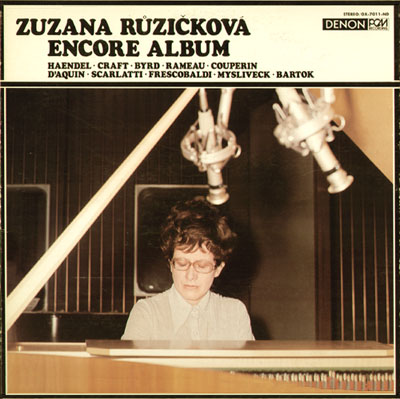
From then on Nippon Columbia (Japan) produces digital recordings and releases these on the Denon record label. The low quantization and bandwidth and the ringing of filters to prevent the mirrored audio band (aliasing) from interfering with the musical signal, prompt many audiophiles to say: "You can hear the switching." As if the variations of the samples and bits is the same as the shifting of gears in a race car. What they actually mean is that they are aware of the fact that the sound shifted from one dynamic level to another, from one bit to another. The later recordings done with 16 bit quantization are of course of a much higher quality and some are quite stunning in sound if compared to the later CD releases. Why? That will be explained later in this article.

Large Catalog
A gradually growing catalog is offered to the record buying public with popular music, jazz, folk, and classical music. The classical recordings feature flute player Jean-Pierre Rampal, the Josef Suk Trio, the Tokyo Metropolitan Symphony Orchestra conducted by Louis de Froment, pianists Maria Joao Pirez, Anne Rose Schmidt, Vlado Perlemuter, Deszö Ranki, cellist Janos Starker, violinist Josef Suk, organist Helmuth Rilling, to name a few. From 1982 on many of these recordings are made available on Compact Disc also.

The specificatisons of Denon's PCM recording system:
Pulse Code Modulation: 44.1 kHz/14 bit
Dynamic Range: > 89 dB
Distortion: < 0.1 % at 0 dB level
Crosstalk: < -80 dB.
Frequency characteristic: DC - 20 kHz, +/- 0.2 dB

Miller & Kreisel and Sony
In the beginning of digital recording Sony U-Matic recorders in conjunction with separate converter modules are used. Sony develops their PCM 1600 Digital Studio Recorder which becomes very popular. It is eventually replaced by their PCM 1610. As these become available, more labels start recording digitally. Miller & Kreisel is such a label. The recordings are made with a Sony PCM 1600 with a sampling rate of 44.1 kHz. and the dynamic gradation of 16 bits. Jonas Miller and Ken Kreisel design their own electronics and modify the microphones. Their objective is to achieve a recording with the least phase shift and name it M&K RealTime Recording Process.

Soundstream, Telarc, Digitech, a.o.
The producers and recording engineers of Telarc, and Digitech use a different digital format. It is devised by SoundStream and has a sampling frequency of 50 kHz. which results in a slightly wider frequency band of theoretically 25.000 Hz. But what is a high resolution PCM recording format? The format of the Compact Disc with its 16 bit and 44.1 kHz. or the 48 kHz. of the digital audio recorder (DAT) can hardly be called high resolution formats, nor can the Soundstream digital technique.

Specifications for the Soundstream Digital Recording System:
Frequency Response: Flat from 0 to 21 kHz.
(- 3dB at 22 kHz.)
Total Harmonic Distortion: At "0" VU, less than 0.004%
At peak levels, less than 0.03%
Signal to noise: 90 dB RMS Unweighted
Dynamic range: 90 dB RMS, Unweighted
Sampling Rate: 50.000 samples per second
Digital Format: 16 bits linear encoding/decoding
Wow and Flutter: Unmeasurable
Data taken from Digitech DIGI 103 with Anthony Newman on the Historic Hilborne Roosevelt Organ (Great Barrington, Massachusetts.)

Sharp's prototype of a digital audio disc with 16 bit quantization and 44.1 kHz. sampling rate, stored on a 13.5 cm disc.

Pioneer and Sharp
In 1980 a committee discusses the standard of a future digital disc once again. Pioneer proposes a digital audio disc with a diameter of 13.5 cm instead of 30 cm (12"). The sampling frequency shall be between 44.1 kHz and 50.4 kHz. It will be a linear format with 16 bit. The maximum playing time will be 60 minutes. The disc shall be playable in their Laser Video Players made for 12" video discs.
Not much later Sharp presents a prototype in accordance with the format proposed by Pioneer. The actual digital format of Pioneer and Sharp is incompatible with the disc Philips and Sony are working on. However, the presentation by Sharp of their PCM digital audio disc, makes it all too clear that if Sony and Philips want to set the world standard, their cooperation has to be successful.

The development of the Philips Laser Video Disc (LaserVision) and its player led to the creation of the CD-Video Disc and Player (introduced in 1987) thus paving the way for the DVD.
Picture taken from the brochure introducing the CD-Video format.

Sampling Frequency
Also the format Philips is working on is a linear system. This means that the number of samples vary with the frequency. The higher the frequency the fewer the samples. It also means that the width of the frequency band for audio depends on the chosen sampling frequency.
In order to measure sound one sample is not enough. It is necessary to have at least two references, or samples, as I.S. Reed and G. Solomon had made clear.
If we want to use the audio band of 10 to 20.000 Hz. we need at least two samples of the top frequencies. The result is that a sampling frequency of 44.1 kHz. gives a frequency band extending to half of that frequency, 20.500 Hz. A higher sampling frequency will result in a wider audio band. The later adopted 48 kHz. for the Digital Audio Tape Recorder (DAT) means an audio band extending to 24.000 Hz. A sampling frequency of 400.000 Hz. would mean an audio bandwidth from DC to 200.000 Hz. and practically no phase shift. The maximum resolution of a system is dependant on the clock frequency which in 1980 is rather low. A higher clock frequency gives a higher bit rate.
That is the time when computer freaks are working with a Sinclair, a Commodore, an Atari, with 8 bit and a CPU with 4.43 MHz., storing data on a casette tape with time consuming writing and reading.
Petition
When word gets around that Philips will propose a digital disc with the 14 bit/44.1 kHz format, editor/publisher Peter Aczel inspires the readers of The Audio Critic to send postcards to Philips in Eindhoven, the Netherlands, to urge the engineers to choose a sampling frequency of at least 50 kHz.
But in fact even a sampling frequency of 50 kHz. would not be high enough to satisfy the discriminating listener, as only a much higher sampling frequency can produce upper harmonics and a true transient response.
Further Development together with Sony
After consultations with Matsushita (Technics) and Sony, it is Sony who joins Philips to finalize the development of the Compact Disc. Philips has a 60% interest and Sony 40% in the joined venture. Apparently Philips is mainly responsible for the laser technology and Sony for the correcting codes. You all know the story that the capacity of the CD should enable the complete recording of Beethoven's Ninth Symphony, as Herbert von Karajan suggests. All physical and digital data are contained in The Red Book. But you only need ears to be able to judge the benefits of the medium.

Prototype of the CD. Like the Lp it has a paper label and the cover is a sleeve of thin card board. The jewel case has yet to be designed.

1981: Festival du Son in Paris
In the Spring of 1981, well before the official introduction of the CD, Philips demonstrates their newly developed Digital Compact Disc at 'Le Festival du Son' in Paris. People are elbowing their way into the small auditorium to witness this historic event. When a Philips engineer needs to check the equipment and lifts part of a long and wide, gray curtain, it is immediately clear that Philips uses stacks of electronics: amplifiers and cabinets filled with digital circuitry for converting and correcting the signal. The interconnecting cables are thick and heavy. It shows all too well that at that time the elaborate circuits and complicated modules for conversion and correcting any mistake made while reading the disc, has not yet been reduced to a few ICs, chips and a couple of operational amplifiers. The cabinets filled with components recall pictures of a demonstration at a World Fair in the early years of the past century. There is something primitive about it. But there is also the thrill of witnessing the beginning of a new era: sound recording and reproduction by means of a computer. The development of tiny converters and operational amplifiers is certainly on its way. But no risk shall be taken during such an important demonstration. Yet it will not take long before electronic circuits and converters are reduced to the size of a mere IC.
Louis Armstrong and Mussorgski
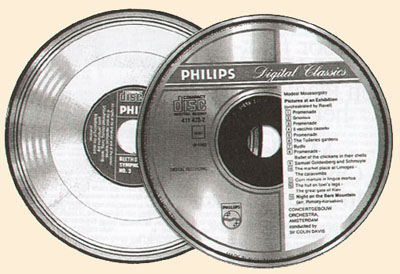
Many do remember the demonstration of Louis Armstrong's digitally remastered trumpet, sounding round without a chiseled top. Also an original digital Philips recording of Mussorgski's "Pictures at an Exhibition" performed by the Concertgebouw Orchestra, conducted by Sir Colin Davis, can be heard. The introductory trumpet sounds indeed unstable, is shifting in intensity from bit to bit, as it is recorded at a low level. Apparently no dither is added as it is not yet en vogue. The recording is also issued as Lp with reference number 9500 744 and a few years later as CD 411-473-2. Listening to this recording in whatever format, it is clear that the recording technician is still "thinking analog".
The reason for the less than precise reproduction during the demonstration is not because the new constructed format does not work properly. It certainly works as correctly as the format dictates with the components of that moment. The actual reason is that the format is too restricted to really render the nature of the trumpet. Philips demonstrates with 14 bits converters, eventually enhanced with the technique of noise shaping. Only much later pure 16 bit conversion in combination with oversampling is applied in the Philips CD players.
Yes, the demonstration shows that the sound is as clear as light. That is true. But the demonstration makes clear that the sound is also incomplete.
And when two years later the first Philips player, the CD-100, is introduced, many a music lover can hear the "clear'' sound in their own listening room.
Remarkable Feat
No doubt, the creation of the Compact Disc is a technical feat of the highest order.
Taking the given format of 44.1 kHz. and 16 bit, designing a method for storage, incorporating algorithms with the codes for the signal, the correction of the signal, for the steering of the disc's speed in order to ensure the same density of information at every diameter, adding calculators for restoring the signal if a reading would be incorrect, and finally putting the audio signal plus this extra information, including the filtering, in a series of pits on a very small disc instead of a heavy, 12 inch silver disc as other manufacturers propose... that surely is a technical miracle. And do not forget about designing and building a pressing plant where all vital aspects of the production in a dust free surrounding are attended to (though in the first years many discs show imperfections and cannot be played entirely). And finally the development of the design of a container (jewel case) which protects the CD makes the product complete. If you want to know more about the details of the technique, you can consult Giesbert Nijhuis page.
At right: Philips Lp 9500 744 and CD 411-473-2 respectively.
Point of View
That is looking at the medium from a technical point of view, that is looking from the point of view of the proud engineers of the Philips laboratory, the point of view of the Sony engineers, the point of view of the marketing people and the record companies who - first reluctant - finally will accept the new world standard, a format with a channel bit rate of 4.3218 Mb/sec and a data bit rate: 2.0338 Mb/sec. Yes, there is no dust in the groove, there is the absence of the sound of the stylus in the groove, there are no scratches, there are no dents, no pressing bubbles. But the serious music lover who knows how acoustic instruments do sound, is judging the new medium with cautious ears. It is said that the late Jaap van Ginneken (producer, Polygram Records) has his doubts.


Comparing Apples to Oranges
In the early days of CD, one journalist was complaining that there were readers of his magazine who did not like the CD. He compared that attitude to that of music lovers in the early years of the Lp. They did not like the dull sound of the (early) Lp if compared to that of the 78 RPM direct to disc recordings. That journalist made of course a mistake. The change from 78 RPM to Lp cannot be compared to the introduction of the CD. Both shellac and vinyl in the nineteen fifties had high resolution analog sound, restricted by the bandwidth of the respective carriers. And that is completely different from digital encopding and the problems it poses. It is not only the resolution but also the correct phase which is of the utmost importance.
However, it is the convenience which leads to the general acceptance of the CD format and this prevents the inventors to develop another PCM format with a much higher sampling frequency, higher quantization and consequently a higher bit rate. There is no alternative!

16 bit and 44.1 kHz.

Bandwidth
The chief determining factor of the linear recording system is the sampling frequency. In case of the CD it is 44.1 kHz.
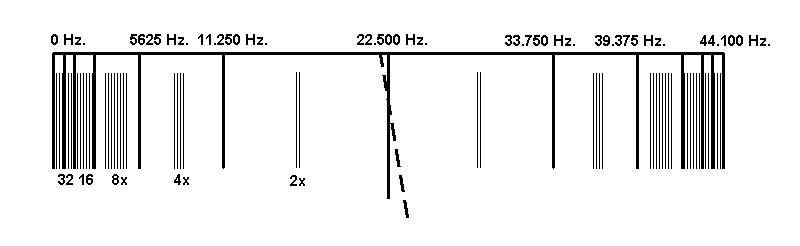
In order to measure a frequency (sound), at least two samples are necessary. This means that the maximum frequency of the audio band is 22.050 Hz. (in theory).The higher the sampling frequency, the more extended the audio band will be. For example: 48 kHz. as applied to the DAT recorder sets the upper limit of the audio band at 24 kHz.

700.000 Hz. Sampling Frequency
Already in the early nineteen eighties I remember fantasizing with John Watson (of Mission Electronics at the time) about a very high sampling frequency of say 700.000 Hz. well knowing that this will result in a high resolution sound recording. Or take the sampling frequency of 400.000 Hz. as is the argument of designer Tim de Paravicini in the nineteen nineties. That frequency will give an audio band extending to 200.000 Hz. This means that the number of samples at 20.000 Hz. is 8. And this brings about the same resolution of the professional reel to reel tape recorder. And a phase coherent 6 dB filter is sufficient. To some 200.000 Hz. may seem rather far fetched. In the analog days a basic bandwidth of 400.000 Hz. for sophisticated phono stages is not at all uncommon.

  Aliasing
In the linear CD the audio band up to 22.05 kHz. is mirrored, has an alias. Not a bit of the 22.05 to 44.1 kHz. band shall interfere with the music. In order to prevent a mix up, the insertion of a steep filtering by means of a so called brick wall filter, is applied. In theory the slope of that filter should be 96 dB. That is a very difficult value to implement with an analog filter. That is why sometime later the filtering will take place in the digital domain. This makes it possible to insert a less steep filter in the analog domain.


Samples
The number of samples in the audio band is frequency dependent. The lowest frequencies are being measured many times more than the top frequencies. The frequencies from about 11.000 Hz. to 20.000 Hz. are sampled only 2 times.
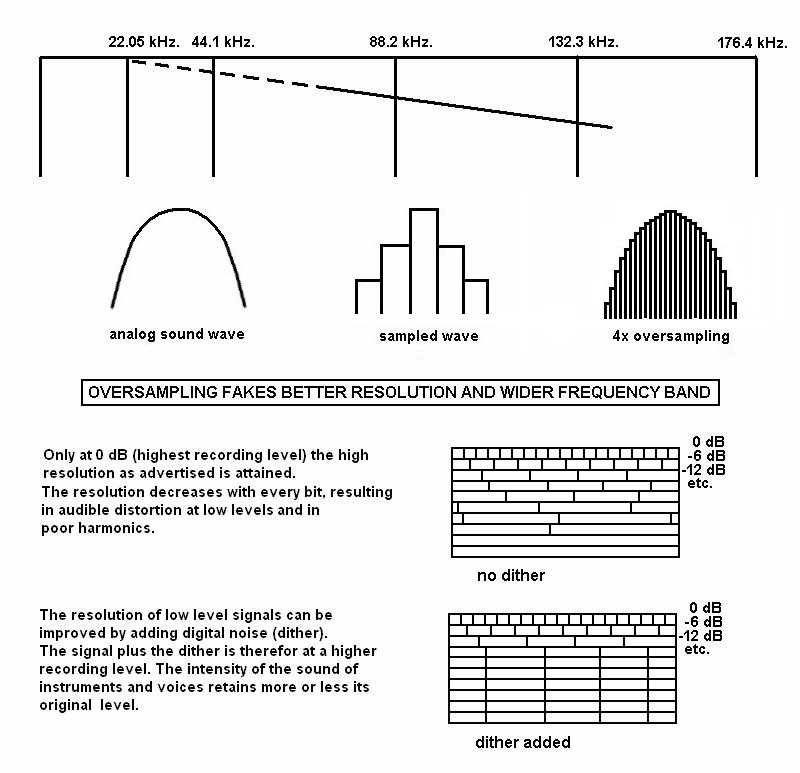
There is another important trait of the CD format. The highest resolution of the sound is attained at the loudest level, that is at 0 dB recording level. 0 dB gives also the least distortion. At lower levels, the resolution is less and is not in line with that of the 0 dB level. The lower the level, the less the resolution.
Every bit measures 6 dB. 16 bit means a dynamic range of 96 dB, no matter if the original recording was made at 20, 24, 32 or even 64 bit.

Oversampling

Refining
The computer of the PCM recorder has a steep filter otherwise recording was not possible. The same goes for the CD Player. There is however a way to avoid such a filter with a very steep slope. The Philips engineers introduce the so called oversampling. This is a very clever technique. By multiplying the sampling frequency by 4, the sampling frequency will be seen as 176.4 kHz. instead of 44.1 kHz. and an audio bandwidth of 88.2 kHz. is suggested. This also means that the aliasing is far away from the music signal, the actual audio band of 10-20.000 Hz. Yes, 176.4 kHz. would be quite an ideal sampling frequency. Such a high frequency does not need a steep filter. This multiplication has the benefit of "interpolation". Steps between one level (bit) and the next level (bit) are being generated. This results in a more analog like sound wave.

16 Bits
The 6 dB per dynamic step does not promote refinement.
A sound that is not at the exact measuring level, will be given the value of the nearest level. The drawing above shows how a specific loudness is attributed to a lower or higher step/level of 6 dB. without the use of interpolation. In other words, if no interpolation would take place, a sound of 2.9 dB above -6 dB would be attributed the value of - 6 dB. A sound of 2.9 dB below 0 dB would be attributed to 0 dB. That is why people, especially in the beginning of the CD era, would say: "It is a violin, but not exactly a violin." Every pianist knows that a digital recording of a piano has less "depth" than an analog recording can have. In other words: the deep sound of the singing of the strings is less.

Reverberation and Depth
This is also true for recordings of orchestral music. In the beginning the recording equipment was not as sophisticated as it is today. In order to give the sound of the recording of Symphony No. 4 of Anton Bruckner with Bernard Haitink conducting the Vienna Philharmonic Orchestra more depth, recording engineer Volker Strauss took the ready tape to a little church in Veluwe region, played the music and added a well chosen amount of the natural reverberation of that church to the final tape to be released on CD. Without this measure the music would have sounded less agreable, would have less depth, would be more "dry", so to speak. Volker Strauss said so when interviewed for Dutch opinion weekly "Vrij Nederland".

96 dB
Because there are 16 bits, the difference between silence and loudest music (the dynamic range) is 96 dB. The quantization of 16 is a rather low number. At the time of the development of the Compact Disc a higher number of bits was not feasible. Today 64 bit can easily be applied when designing a format. But in 1980 16 bit is the maximum and already superior to the 12 bit/32 kHz. which is then used in broadcasting transmissions. And it is very superior to the 4 or 8 bit of a simple computer. The higher the quantization, the more depth the sound has. (Note: This adagio is also true for images made with a digital camera and with a scanner.)

Restriction
You can make a recording at 20 bits, 24 bits and even 32 bits using a digital tape recorder or a computer with a hard disk, if these do allow you to make such recordings. Or make a 700 bit analog recording. Fact is that the CD has no more than 16 bits and in whatever format you record, it will be transposed to 16 bit and 44.1 kHz. sampling frequency in the end, the unchangeable format of the CD.
As the CD-Player is in fact a computer system, all sorts of calculations, multiplication, additions and substractions in the algorithm are possible, after the recording has been made in the standard format of 1982. Oversampling and upsampling are blessings for the manufacturers and recording companies, but also for the lovers of the convenience of the Compact Disc.

Sigma Delta

All drawings Copyright by Rudolf A. Bruil

High Resolution Digital
There is another way of devising a digital format. It is a system by which every frequency is measured with the same sample rate. That is what originally is called the sigma delta method. The name is later used for high quality linear converters. This gives a more analog like sound reproduction as the resolution is very high, also of the high frequencies and there is no need for oversampling.
However, with this method the resulting frequency characteristic is not a linear curve. A correction over the entire audio band has to be applied in order to arrive at a linear curve for frequency and dynamics.

Natural Harmonics
As the number of samples is the same over the entire audio band, there is the same resolution and depth at every dynamic level: the same high resolution with every bit. While the linear digital formats suffer from inaccuracy at low recording levels, the resolution of the nonlinear (delta sigma) format is the same at all dynamic levels, loud passages or soft music. The harmonics are therefor very natural and logic. (Note: Digital photography suffers from the increasing inaccuracy at each lower level as the linear digital audio formats do.) Needless to say that the sigma delta asks for extremely clever calculations and corrections in order to have an impeccable, linear audio band in the end. In 1980 - let alone in 1967 - such a complex method is only a theoretical option.

Sophistication

ln the Beginning
In the beginning, the CD is not at all the sophisticated medium as we know it today. In the first years the percentage of rejected CDs with pressing faults is high. The spiraled track with the small pits has less than 1.6 micro meter room.
Also problems in connection to the conversion and the precise reconstruction of the wave form, the filtering and the further refinement of the sound have to be addressed to. Yes, the sound quality is related to the recording equipment, the amplifiers used for the transfer of the data, and the CD mastering.
The consumer however is concerned by the quality of the CD-Player. It is possible to encounter players with converters for the left and right channel which are not exactly the same. It is possible that they do not give maximum stereo, or deliver more than the advertised distortion, or have a less perfect frequency curve.

Most Significant Bit
Important in this respect is the precise adjustment of the Most Significant Bit (MSB). As the bits are 6 dB which is a rather large span, a small irregularity does impair harmonics.
The manufacture of converters and the precise adjustment of the MSB are expensive. This eventually leads to the appearance of low bit converters. By he way they function, the error is reduced to a small percentage. But they shows other less agreeable aspects.
In
the first years of its existence, the anomalies and imperfections are not generally accepted and many articles are written and published about the "digital sound" of the Compact Disc.

CD-100 by Philips

CDP-101 by Sony

Acceptance
Not only high end magazines like Stereophile and The Absolute Sound, a.o., also Stereoplay and Audio in Germany, IAR in Canada, HiFi News in Great Britain, in fact all over the world audio journalists are reviewing the players and are coming to grips with the benefits and the anomalies of the new format. They report on every little improvement.
Also manufacturers of electronics have difficulty in optimizing their amplifiers. Designers of loudspeakers are also doing their best in striving for a precise reproduction of the high frequencies. There are loudspeaker systems that cannot handle the fierceness of the treble and tweeters are easily blown up. And those who do not see the signs of the time see their position and rank in the market going down.

Thorens
Armin Graf, managing director of Thorens A.G., publishes a magazine article with the meaningful title: "CD, A Mis-performance" (CD, eine Fehlleistung). He argues that most people have never heard the high quality reproduction of the high resolution analog black vinyl disc. He is right of course, as only 5 to 10% of people have ears and probably have invested in some sort of quality audio. And the rest? It is true that many a lover of pop music, often does not care whether the disc is slipped back into the cover when partying. Some seem to use the Lp as a Frisbee. Many forget about checking the diamond tip at regular intervals, unaware of the significance of maintenance. For those the CD is a blessing. However, many fans of classical music and serious collectors of jazz do care about maintaining the high quality of the Lp. Armin Graf certainly writes the article also because Thorens is afraid to loose their market, which they eventually do before starting anew.

Solutions and Improvements
Various manufacturers of CD-Players and converters try to improve the reproduction of digital recorded sound. They incorporate valves in the amplifier stage: California Audio Labs, Luxman, Sonic Frontiers, Musical Fidelity. Beard produces the DAP1 with 3 sampling frequencies, three 16 bit converters appying 4 times oversampling. Filtering is practically unnecessary. The DAP1 works fantastic with the Philips CD-822 unit, illustrating that not every DA-Converter gives the same performance with every player. Cambridge Audio places up to four converters in line to eliminate the brickwall filter (Cambridge Audio).
Many hear the restrictions in the top frequencies and many argue that the reproduction of frequencies beyond 20.000 Hz. is necessary for the perception of the complete nature of the sound of acoustic instruments. Some manufacturers do recognize this and start devising specific ways of conversion in order to suggest an extended frequency band.
Guiston CD Converter
In the nineteen eighties it is Marc Guisto from France, designer of the remarkable Guiston tube amplifiers and loudspeaker systems, who uses the capabilities of the RIAA phono stage: a minute signal is presented to an amplifier stage with a wide frequency band for optimum harmonics and transient response. He designs his "convertisseur numerique-analogique", which of course is not a DA-Converter in the strict sense.
He applies a correction to the mostly 150 mV output signal of the analog stage of the CD Player and brings the level back to a few milli Volts, changes the characteristic slightly (which is different for every type of brand of player), applies a filter (-3dB at 20 kHz.), and applies the RIAA correction for the Lp. Now the outgoing signal can be connected to the RIAA stage (phono inputs) of the preamplifier and a clear refinement of the digital sound is the result. Click on the image to see a larger picture.
new window

Pioneer: Legato Link
When listening to old records pressed in the nineteen fifties and sixties, the hiss and surface noise do suggest a wider frequency band than the actual recording has. The noise mixes with the sound of the instruments. This is the principle Pioneer uses in their "Legato Link" conversion introduced in 1992. They use the noise above 22.05 kHz. which normally is being filtered out. This noise is of course filtered. The engineers devise a method of connecting this noise to the audio frequency band containing the music. If the level is carefully adjusted, the sound of the cymbal, the cello, the violin, etc. is reproduced with uncanning naturalness. If the level is too high, the sound is no longer recognized as being natural. Click on the picture at left to view a larger image.

Denon: Alpha Processing
The Denon engineers follow a completely different path. After analyzing the complex algorithms of the CD they find a way to extract and use data from the lower, least significant bit, well before the actual conversion takes place. These data represent pulses of sounds with high dynamics occurring mostly at the beginning of a sound. These data are processed in such a way that they are added to the actual converted wave form. In popular terms, the steep filtering around 20.000 Hz. is disabled for a few milliseconds every time the data give a specific value. The disabling can be just once in a while or can occur repeatedly. During these instances the width of the frequency band is not limited by the conventional process of conversion and its brick wall filter. No, it extends beyond 20.000 Hz. In this way upper harmonics can be generated. The result is that all acoustic instruments do sound more natural, have an analog quality. The Denon engineers call it "Alpha Processing" and introduce this conversion type in 1993. In designing their flagship DP-S1/DA-S1, they also pay the utmost attention to the construction and functioning of the CD-turntable.

The benefits of Alpha Processing are not only heard, but can also be measured. Look at the four wave forms at the left:

a = An original 1 kHz. sinus wave.

b = The sound is digitally recorded at minus 90 dB and after being treated by a multi bit D-A converter, the sinus is more like a small number of stairs. The level of -90 dB is of course an extreme low recording level, chosen to demonstrate the workings and benefits of Alpha processing.

c = The signal is converted by means of a low bit or single bit D-A converter. The sinus looks like a woolen thread still showing the rudiment of the stairs. The oversampling of 256 times also multiplies the smallest inaccuracy and distortion 256 times. This noise is audible in a low bit CD converter and in the SACD (Direct Stream Digital) conversion. This distortion has to be filtered out by means of a noise shaping filter.

d = If the signal in the PCM Compact Disc format is retrieved and converted using alpha processing, the sinus is as the original.

  Accuphase
Despite the introduction of low bit converters, which are cheaper to produce, there are manufacturers who stick to the precise adjustment of every bit. They are the adepts of the multi bit conversion and use high quality Burr Brown converters. To arrive at a very precise and analog like sound, the engineers of Accuphase take 4 converters for every bit. The result is that the dynamic steps are more refined. But not only that. The distortion is decreased by a factor 4 which is important for lower levels where common DA-Converters show the original high levels of distortion.
It's Only A Paper Moon
Also hobbyists take part in the discussion and many a recipe they come up with to remedy a specific problem, often turns out to be just snake oil. Or the solutions are valid for the audio set of that individual only. And many times the differences are just too subtle for one aspect while neglecting another.
The best CD Player uses multi bit converters which are precisely adjusted. The best CD Player has a regulated power supply, and has a well constructed and carefully dimensioned, damped cabinet, in order to produce a wide and deep sound stage. Yes, despite the bits and bites, here on earth we are still living in a material world! First attention has to be paid to the cabinet and resonating moving parts. Only than... high grade capacitors to filter the signal and specific resistors can be changed. Only than sophisticated operational amplifiers can be fully effective and only than will contribute to the naturalness of the sound! Even without replacing the original (ordinary) components, the player can deliver a high qualitry audio signal if the cabinet has been treated carefully and selectively while listening to the effect of every mechanical modification made in specific places


Practice Makes Perfect
In the early days of the CD most recording technicians and sound balance engineers need to get to grips with the new medium. They discover that the microphone placement used for analog recording is not valid any longer. Instruments and instrument groups need closer miking. Otherwise the less than perfect resolution at low recording levels will be noticed. If the clarinet in Gershwin's "Rhapsoy in Blue" is positioned in the back of the orchestra, far away from a microphone, it is possible that the shifting from one dynamic level to another (from one bit to another) can be heard. The addition of dither (a low level of digital noise) brings the sound a few bits higher and it can be recorded more precisely.

Close Miking
Using more than three microphones (as in Robert C. Fine's Mercury Living Presence recordings) and position these close to the instruments or groups of instruments (multi-miking) will easily result in differences in phase (time) and harmonics can be canceled out. Not only the harmonic build up of sounds but also the stereo image will suffer. Attributing to each microphone (or group of microphones) a separate AD-converter which allows phase correction, is the solution.

Blessings
In 1986 a recording engineer/producer tells me that the Compact Disc needs a completely different approach. The already mentioned recording of Mussorgski's Pictures with the Concertgebouw Orchestra and Sir Colin Davis is the audible proof that in the early days of digital, the technicians are still thinking analog which results in a less chiseled sound character of this very well recorded performance.
It is more and more recognized that the restricted format of the CD is also a blessing. Now the format is more or less prescribing what the outcome will be: 44.1 kHz. is 44.1 kHz. and 16 bit is 16 bit.

Evolution
Gradually the converters are being improved upon. And further understanding of the algorithms result in software which is getting better and better. And then there is the benefit of breaking the codes for all sorts of editing purposes. The signal can be copied, pasted, repeated and it can be changed (cleaned). The re-recording and editing of historical performances is possible.
And last but not least, by incorporating the CD in the personal computer as a recordable disc, the CD has become the most democratic medium in history.
However there is no medium for sound recording which took so much work and development over such a long period as the Compact Disc because of its unchangeable computer format. The introduction of PCM recorders like the Tascam DVRA1000HD High-Resolution Audio/DSD Master Recorder with Hard Drive, which can make recordings at up to 192kHz/24-bit PCM resolution, can reinstate the term "high fidelity" in the vocabulary of tecnician and music lover. There are exciting times ahead.

The Versatile Lp


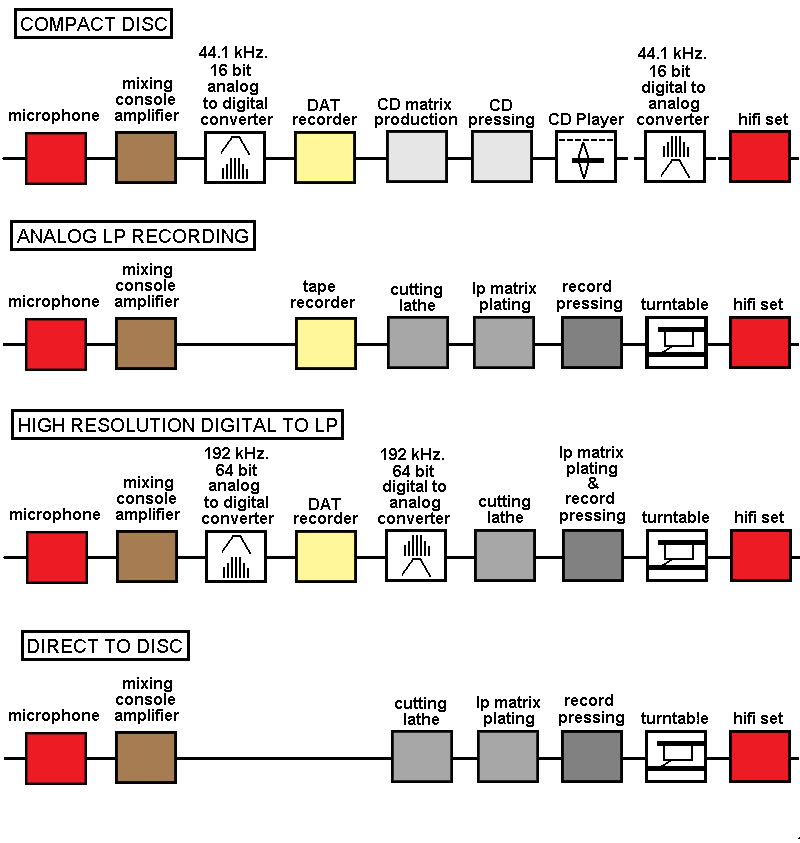
Diagram representing the most important steps and components involved when recording and reproducing sound with the use of a digital or an analog format.

Many lp record collectors have noticed that a vinyl record containing music which originally was digitally recorded can sound much better than the CD equivalent. This is mainly for three reasons.

1. The digital information was converted to analog with quality converters and were equalized.
2. The playback of the record profits from the wide frequency band of the RIAA stage and is filtered with a 6 dB filter (coherent phase) above 20.000 Hz.
3. The interaction between diamond tip and groove results in a high rise time without delay and generates upper harmonics which give a better transient.

Expensive
The analog direct-to-disc recordings are the most expensive and the most ideal when judging on quality of sound alone. The drawback of the vinyl long playing record is however that only a restricted number of copies shall be pressed. A number of 1500 per matrix is the maximum if a relatively high level of quality is to be guaranteed.
Less attractive is also that the vinyl disc is easily damaged.
On top of that, the gramophone record asks for a high quality playback system: the optimum turntable-arm-cartridge-amplifier combination. In principle the Compact Disc does not have these drawbacks. The signal can be copied with a minimum of loss or alteration.

Limited Frequency Band
The restriction of the CD is the chosen sampling frequency which sets the width of the frequency spectrum of the format. The chosen number of bits determines the dynamic detail and the depth and harmonic build up of the sound. The 16 bit and the clock frequency of 7 MHz. of 1982 look rather poor if compared to the 64 bit and 4 GHz. processors with which modern computers are operating.
It is clear that a digital format with a higher sampling frequency and a greater number of bits will come closer to the analog sound recording. However to play back such a format, consumers will have to buy a new player for the new digital disc.

Analog Lp Record and UDF
The gramophone Long Playing record - despite its physical shortcomings - can again demonstrate its versatility. Sound which is originally recorded in a high resolution digital format can be engraved in the analog disc. No need to manufacture a player for that format, unless the UDF-Players of the future can accept extra boards with the appropriate converters.

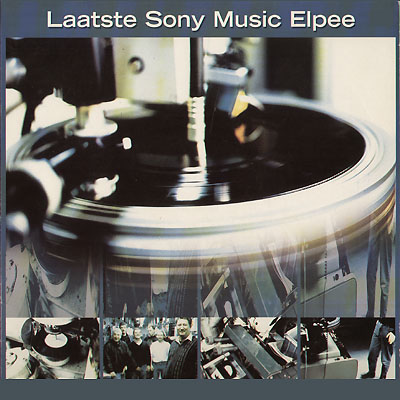
At left the covers of The Last Sony-CBS Lp pressed in the Netherlands in March of 1998. The factory was sold and is still pressing some 6 million records a year.

The other cover is of digital Philips Lp 6570 994 from 1981 including a catalog of the first Philips digital recordings of classical music.

© Rudolf A. Bruil. Page first published on August 17, 2007 and expanded since.
This is the translation and adaptation of an original article,
written in Dutch and published in the Spring of 1993.


Top of Page

Home | Audio & Music Bulletin | SACD The Sound of Noiseshaping |
LP List | Record Cleaning Page | Ortofon/Decca/Tannoy Cartridges |
The Remington Site | Record Stabilizer Ring  | Record Weight | Links 

Audio&Music Bulletin - Rudolf A. Bruil, Editor - Copyright 1992-2007 by Rudolf A. Bruil and co-authors