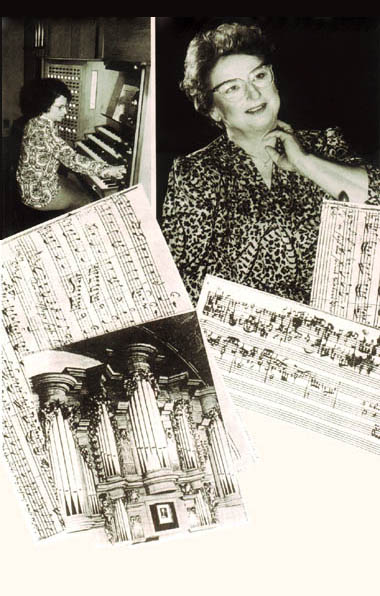
|
|
|
|
|
Though
Marie-Claire Alain is the grand lady of the organ, she is not
a very tall person and one wonders how she succeeds in handling
such a colossal instrument consisting of pipes, bellows, hoses,
manuals and complex registers. Nothing seems impossible for Marie-Claire
Alain. She manages a sober canon or a complex fugue from the baroque
repertory as well as a heavy, sonorous symphony from the romantic
organ literature.
It
is one Monday morning in September of 1988. We have agreed to
meet in the lounge of hotel "Le lion d'or" in Haarlem,
The Netherlands. Marie-Claire has much work to do during the three
days of the traditional "organ month" in Haarlem, where
organists from around the world meet and discuss and attend masterclasses.
I meet her and her husband - who has been her manager for many
years now - and we engage in an interesting conversation.
RAB:
I have browsed the catalogs and I found that your first record
was a recording from 1958. Is that correct?
MCA:
Oh, that was much earlier, in 1954. In 1958 was the first stereo
gramophone record.
RAB:
That record from '58 was released in the United States by the
Haydn Society. That one from 1954 also?
MCA:
Yes, there was an agreement between Erato and the Haydn Society.
That was the first ever record of Erato. I believe that Jean-François
Paillard made the second one. My disc was called "Pièces
inédites de Bach" (Unpublished Pieces by Bach - Ed.).
Those were pieces which had not yet been put on record. At that
time we had many famous records
of Helmut Walcha, of André Marchal, of Fernando Germani.
|
|
|
|
We have checked the catalogs looking for pieces for that recording
and as I was a little debutante, I was told that we would take
those pieces which had not been recorded before. Regrettably one
cannot do that nowadays. (She laughs.)
RAB: Have you known Helmut Walcha?
MCA:
Not personally. I have often listened to his recordings, which
I admired very much.
RAB:
It was he who in the nineteen fifties...
MCA:
On the record market it was he who was admired the most.
RAB:
And Jeanne Demessieux?
MCA:
I have known her well. I even met her here in Haarlem. The first
year I came to Haarlem to give lessons.
RAB:
You are here in the framework of "the organ month".
("De orgelmaand", Ed.)
MCA:
I am here for three days and will give three courses to organists
concerning the works of my brother Jehan Alain. And tomorrow night
I will give a concert in the Bavo, the big church, on the famous
organ of Christian Müller.
|
Marie-Claire
Alain was born in 1927 in Saint Germain-en-Laye (Yvelines,
France), the birthplace of another great French artist,
Claude Debussy. She studied organ with the great and famous
Marcel Dupré at the "Conservatoire national
supérieur de Paris". She won many international
prizes and awards and is regarded as the eminent performer
of the early music for organ. She recorded compositions
ranging from Buxtehude to Messiaen including the complete
works for organ of Johann Sebastian Bach. She recorded
an impressive discography. Precision and personal freedom
are the traits of her character and of her musicianship.
Her convictions concerning style, her lively spirit and
her sense for analysis and study make her also an admired
teacher.
1976 marks the year in which her millionth record was
sold. In the same year she received the Buxtehude Prize
from the city of Lübeck. In 1980 she was awarded
the "Leonie Sonning Foundation Music Prize"
from the City of Copenhagen. For her outstanding Liszt
recording she received the "Budapest International
Liszt Record Grand Prize" in 1987. She does not restrict
herself to the music of the baroque era. On the contrary.
She made recordings of works by Mozart, Fauré,
Poulenc, Jehan Alain, Handel, Saint-Saëns and Vivaldi.
|
|
|
RAB: There is often talk about the "nouveau style" in
the interpretations of the music from the baroque. You recorded
two times the complete works of Bach...
MCA:
Yes, even three times. In fact not three times completely. Recently
I have made other records because the musical interpretation is
a continuous evolution. You just asked about the new style. Here
in Haarlem we started to elaborate those problems of the execution.
Many organists have always been part of that movement - from a
distance or from close by. And for me it is the start to renew
my way of playing; I have always informed myself without loosing
myself in that movement completely. That was important for me.
RAB:
You play Bach completely different than...
MCA:
...Than in the nineteen fifties and sixties.
RAB:
Is that a big difference for you?
MAC:
Yes, everything had to be altered. Not just the finger notation,
even the way you hold your hands. That is difficult if you are
already a performing artist.
RAB:
You were used to the traditional way of playing.
MCA:
I was used to it, but I did not always agree with what had been
taught to us. For me it has not been difficult to search for new
ways. I felt the necessity of it, I had a need for change.
RAB:
Don't you think it can restrict the interpretation?
MCA:
Not at all, on the contrary, it gives more ease if you master
the difficulty - the so called difficulty - of the finger notation.
The music has been written in that finger notation. And many passages
which seemed to be very difficult to us, now became very easy.
I, knowing the two ways of playing, maintain that the new way
gives more comfort. Many people had to make a clear effort. But
if you master it, than this new method is much easier.
|
|

The
magnificent Müller organ of the Great or
St. Bavo Church in Haarlem, the Netherlands.
Picture taken from CNR SPES 8201, Albert de
Klerk playing
Fantasy in F (Mozart) and Variations on
"Our Father, Thou Art in Heaven" - "Vater
unser im Himmelreich" (Mendelssohn).

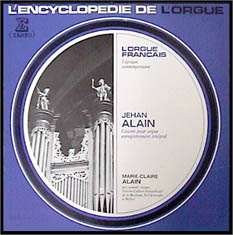
The
complete works for organ of J.S. Bach were released on 24 LPs
in a beautiful cassette, including an additional LP featuring
an introduction and an interview with the artist.

|
|
RAB: Can the rhythmic movement change because of it?
MCA:
French music was always played with a different rhythm. And for
us, the French, the rhythmic movement gets the same suppleness
which means a certain freedom in relation to the score.
RAB:
Do you have contacts with musicians like Nikolaus Harnoncourt
- the well known renewer - and Ton Koopman?
MCA:
I do not know Harnoncourt personally. I have often listened to
his performances. Ton Koopman I do know personally. We both make
recordings for Erato and we have made a recording of works by
Francis Poulenc. He played the Harpsichord Concerto and I played
the Concerto for Organ, Strings and Percussion.
RAB:
Do you like Poulenc a lot? In the beginning I thought that you
were for baroque music, period.
MCA:
No, not just baroque. I have also an interest for the nineteenth
century. And the first half of the twentieth century.
RAB:
What is the most modern work you play?
MCA:
Oh, I stop at 1950 and at the time I have taken works on the repertory
for which I now, regrettably, do not have the occasion to perform.
In fact one has to be a specialist if one wants to perform contemporary
music. I do not have the time to specialize in that area.
RAB:
Coming back to Bach. You have lived with him for so many years.
MCA:
Yes, sure.
RAB:
You are married of course, and yet...
MCA:
...Let's say that it is sublimated love.
RAB:
What do you like about him?
MCA:
The balance, being a total master of the construction of the instrument.
Bach has written the most beautiful music for organ regarding
the intellectual, mechanical and spiritual aspects. There is a
miraculously beautiful spiritual side.
RAB:
And that is the emotion?
MCA:
That is the emotion.
RAB:
What don't you like about him? Is he severe at times?
MCA:
He is sometimes hard, yes, and sometimes he has a tendency to
be too long, and sometimes a tendency to be too theoretical. In
the late works there are parts which are somewhat difficult for
the listener. Then he is far away from us, his spirit has attained
such a virtuosity that it does not reach us. But if you are able
to follow, it is beautiful. He has - like all composers - written
works that are very good and works that are a little less good.
But despite this all the lesser good of Bach is always better
than the best of many other composers.
RAB:
What are the compositions you love most?
MCA:
Of his complete works? Listen, the great compositions naturally.
I have a special liking for the Fantasia and Fugue in G, for the
Great Prelude in E, for the Fugue, and I have a weakness
for the Trio Sonatas. Those were on my first popular record of
which hundreds of thousands were sold. I find that I have an affinity
playing the trios - that was the first record of my complete Bach.
RAB:
But you also love Buxtehude.
MCA:
Yes, sure!
RAB:
Shortly two CDs will be released...
MCA:
They have already been issued in France. I have played on a very
beautiful organ in Groningen; I try to pronounce it correctly.
|
Marie-Claire
Alain's repertoire spans from the works of the mysterious
Nicolas de Grigny (from around 1730) to the spiritual
compositions of Olivier Messiaen, and including Widor,
Saint-Saëns and Poulenc.
|
|
RAB: Has Buxtehude written as much as Bach?
MCA:
No, not as much, but it is nevertheless a sizable oeuvre,
and it explains much about the youth of Bach. In any case he has
had a great influence on Bach. And Buxtehude is music with which
you can allow yourself a lot of freedom which you cannot permit
yourself with Bach. Because Buxtehude is an improviser, he fantasizes.
And it is music to entertain yourself.
RAB:
Do you intend to record the complete works of Buxtehude?
MCA:
No, I did record it completely once. But now I have selected works
which I consider the most beautiful. I had that privilege. This
is sufficient for me at the moment.
RAB:
Another great improviser is César Franck. Is he also a
favorite of yours?
MCA:
I like to play him under certain conditions. It is clear that
his improvisation is much more controlled. Yet Franck has a style
which is typically French and which I do sense in a natural way.
Marie-Claire
Alain playing César Franck on the Tucek (Kutná
Hora)/Voit (Durlach) organ in Smetena Hall in Prague in 1967
(Supraphon SUA ST 50823).
|

The
impressive organ of St. Laurens church in Alkmaar, restored
by "Flentrop Orgelbouw".
Picture from 'Het
Beste uit AudiOpinie'
Copyright Flentrop Organ Builders.
|
|
RAB: In what way did you learn about the organ
in your youth?
MCA:
It came through family circumstances. I did not choose the organ.
I was born in a family of musicians.
RAB:
Was there a moment when you got acquainted with the organ and
you said to yourself: "This is the instrument I want to play"?
MCA:
As everybody at home played the organ, I initially found it boring
to become an organist. And I wanted to do something else. But
that always brought me back to the organ.
RAB:
You must know Holland very well. There are many organs here?
MCA:
Yes, there are and I have come here a great number of years -
almost thirty years, no, it is exactly thirty years - and I have
been in Haarlem many times.
RAB:
Are there organs of which you think: Ah, these are made especially
for me?
MCA:
There are many beautiful organs. I have not seen the organ of
St. Laurens church in Alkmaar since its restoration. But I would
like to go there very much. Yes, and the organ in Groningen is
very musical. There are so many. The Netherlands are very rich
in beautiful organs.
RAB:
And also in Denmark?
MCA:
Especially in the nineteen sixties many organs were restored.
But Holland made a great effort and is much richer now.
RAB:
Your producer/recording technician is Yolanta Skura. Did you always
work with her.
MCA:
No, I work with her since 1978. Before then it was a Dane, Peter
Willemoës.
RAB:
Is between these two a different way of recording?
MCA:
Yes, because fashion has also changed. In the nineteen sixties
we made recordings which had a lot of presence, but were a little
aggressive. And that is recognized now. And today recordings are
made which are more "softer" and are made from a larger
distance to find the natural acoustics of the church. We always
work with an artificial stereo head (dummy head, Ed.).
These are recordings which have not been manipulated. And sometimes
we look for hours for the best position of the artificial head
with microphones to obtain the best sound of the organ. In this
way we get a recording which is completely natural.
RAB:
When a trial recording has been made and also when the actual
recording was made, do you listen also and give your opinion?
|

Disque
numérique ERA 9266:
Bach BWV 565, 578, 593, 542, 582
Marie-Claire Alain aux grandes orgues
Schwenkedel de la Collégiale de Saint-Donat
|
|
MCA:
Yes, sure, I give my opinion and say if I find "my organ",
yes or no.
RAB:
You say "my organ". But when you play you sit on the
organ bench. That is a different position than that of the microphones.
MCA:
Sure. But after so many years I have learned how the various organs
do sound. I also listen when others are playing. In one way or
another one has to take into account how your playing sounds in
a church. Sometimes I also listen to the tapes in order to know
how the different manuals sound.
RAB:
What is your opinion about digital recordings?
MCA:
Digital, that is very beautiful. That is the best. The CD is for
the organ much better than the vinyl disc.
RAB:
What are your plans?
MCA:
There is a bunch of CDs from me which will be released. One with
work by Olivier Messiaen - La nativité du Seigneur and
Le banquet céleste - and new recordings with Masses of
François Couperin as a follow up of my recordings from
1962. They have already been made and will probably be released
in December or the beginning of next year. Messiaen is a giant
in the music field and this year he will be eighty. He still composes
and his music is always lively. It is music that speaks, that
sings, that gives a lot, though he is at times somewhat systematic.
But he has a miraculous inspiration.
|
Marie-Claire
Alain is also a devoted harpsichordist. She played the complete
concertos for three and four harpsichords together with Robert
Veyron-LaCroix, Anne Marie Beckensteiner and Olivier Alain.
In Germany these recordings were released on the Christophorus
label.
|
|
RAB: It took some years before he really became known.
MCA:
That is the ordeal of many composers. But now that he is so old,
he is recognized as the great French composer he is.
RAB:
Do you still play another instrument?
MCA:
Yes, harpsichord.
RAB:
But that is for...
MCA:
...That is for my pleasure.
RAB:
And if you would not have chosen the organ, would you have taken
up another instrument?
MCA:
No, for no other instrument do I have an affinity.
RAB:
Do you like other musical expressions, like jazz or...
MCA:
Yes, jazz! I do not like rock.
RAB:
Is jazz mood music to you?
MCA:
I can not mention titles, but I like to listen with pleasure to
good jazz from the years nineteen twenty and thirty, New Orleans.
RAB:
And other genres, like opera for instance?
MCA:
Sure. Yes... you asked me if I had not chosen the organ, what
then... then I probably would have become a singer. Singing is
the most beautiful human expression. It is a model for everything.
RAB:
Je vous remercie infiniment Madame.
|
|
|
|
After I have thanked her for the interesting conversation
and for the time she made free, her husband gives me a recent picture
and I ask her if she will permit me to put this heading above the
article: "Notre Dame de l'orgue. Marie-Claire Alain"...if
that is alright?
She smiles as if she, unexpectedly, receives a medal. She is not
just a great organist, our dear lady of the organ.
Note:
The elder brother of Marie-Claire, Jehan Alain, who at 29 years
of age was killed during his military service in 1940, was a talented
organist and composer who wrote many religious works for organ.
Transcribed
from the original tape of the interview in French. Text: Rudolf
A. Bruil
It
was announced on February 28th, 2013, that Marie-Claire Alain
had passed away on February 26, 2013
Marie-Claire
Alain (10 August 1926 – 26 February 2013)
|
|
 NEDERLANDSE VERSIE