 |
|
|
 |
 |
|
Rudolf A. Bruil - This page is an adaptation of an article in Dutch from 1995.
Page first published 2001.
| Thanks to hosting company ARVIXE, my pages are in disarray. Arvixe moved the server from Texas to Provo, Utah without warning and without providing the necessary codes, password and server address. We certainly hope that the inconvenience to you, the visitor, will gradually end will gradually end as the pages are now hosted in the Netherlands. |
CHOOSE A SUBJECT:
ON
SEPARATE PAGES:
Wilma Cozart Fine
|
|
On September 23, 2009, I received a message informing that Mrs. Wilma Cozart Fine had passed away peacefully in her home. She was 82. It is often stated that good sound recording and reproduction have nothing to do with the appreciation of music. In essence this may be true, but it does not exclude the many music listeners and musicians who can admire good sound at the same time and think it is an important ingredient of the live performance and of a recording. Wilma Cozart Fine loved music as well as the technical aspects of sound recording and reproduction. She must have had an inborn interest which started to develop during her early stay with the Dallas Symphony and conductor Antal Dorati and gradually evolved to a high, professional level during her Mercury years. No doubt her marriage to C. Robert Fine was also instrumental in this. Although I met Wilma Cozart Fine only for an hour or so, in 1995, in our conversation, I felt that she was purposeful, and, being a very good communicator, she knew very well how to get her message across. But at the same time she had a friendly gentleness. Although Mercury Records consisted of many more devoted people - David Hall, Claire Van Ausdall, C. Robert Fine, Harold Lawrence, Robert Eberenz, and the valuable George Piros, and others - Wilma C. Fine remained the important link to the glorious past of Mercury Living Presence sound recording. The remastering of more than 100 recordings for the transfer to CD, in the years 1990 till 1995, was a work of precision. Re-releasing the recordings was a prestigious project undertaken by Philips. It differed essentially from the mastering of the SACD releases several years later for which the original Westrex and Western Electric equipment was not used and Revox equipment was used instead. The transfer to SACD was not done by her. Wilma Cozart Fine (March 29, 1927, Aberdeen, Mississippi – September 21, 2009, Harrison, New York) was already a legend during her lifetime. She will be remembered as an expert producer of quality recordings and as an inspiring human being. - Rudolf A. Bruil |


50 Years
Living Presence: 1951-2001
In Roman mythology Mercury
is the god of commerce, manual skill, of travel and thievery.
But he is also eloquent and is the bringer of tidings.
|
|
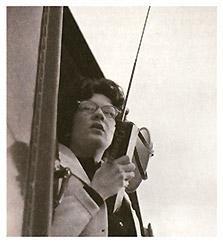
The utmost concentration is essential when mixing the 3 channels of the original Mercury recording tapes to two channel stereo in order to achieve that perfect stereo-balance and a real to life sound at all instances, for all instruments. "Real to life" means: dynamics that are detailed and frequencies that are harmonious in all registers - as is the case in the recording of 'Pictures At An Exhibition' played by pianist Byron Janis on Mercury CD 434 346-2. The grand piano has extraordinary presence and you can clearly imagine that you are almost able to touch the black lid, while seeing the keyboard from the side and part of the bronze frame with the strong, tensed strings, and you hear the wooden construction. As if you were there. It is also a question of microphone placement, of choosing the right position of the instrument in the studio or concert hall and of using top quality tape recorders, playback amplifiers and monitor loudspeakers. But to mix the three channels down to two-channel-stereo when the signal is transferred to a DAT recorder while preparing the CD reissues, that takes as great a skill as the initial transfer to the lacquer in the nineteen fifties and sixties. Obviously Wilma Cozart Fine has the ability to concentrate in abundance. The Mercury Compact Disc with 'Pictures At An Exhibition' is the eminent proof. At left: Wilma Cozart Fine at the Western Electric mixing console and surrounded by a host of components as she poses for the camera at the occasion of the release of another batch of CDs containing transfers of legendary Mercury 'Living Presence' tapes. Connoisseurs can easily spot the modular Audio Suite (designed by Mark Levinson) which is one of the few preamplifiers in the world today that can boast of extreme neutrality. |
|
|
Advertisement in Schwann Long Playing Record Catalog of December 1951, announcing the first releases in the Olympian Series. MG50000, with Pictures At An Exhibition (Mussorgsky-Ravel). MG50001 with Music for Stringed Instruments, Percussion and Celesta (Bartok) and Concerto Grosso for String Orchestra with Piano Obligato (Bloch). Rafael Kubelik conducting the Chicago Symphony Orchestra.
MERCURY CLASSICS
|
LIVING PRESENCE The label or term 'Mercury Living Presence' originated from music critic Howard Taubman's review of the orchestral recording of Mussorgsky's 'Pictures At An Exhibition' (orchestrated by Maurice Ravel) made years earlier. Taubman wrote in the fall of 1951 in The New York Times about that recording, that "one feels oneself in the living presence of the orchestra". From then on "Living Presence" became Mercury's quality slogan that distinguished the label from its competitors and "Living Presence" adorned practically all following Mercury-issues. MG 50000 was reviewed in High Fidelity Magazine, Volume 2, Number 2, of September-October, 1952. Critic C.G. Burke wrote:
Recording projects with Antal Dorati and the Minneapolis Symphony were immediately undertaken: MG 50004 (Borodin, 2nd Symphony, and Stravinsky, Firebird Suite) released in June, 1952; MG 50005 (Berlioz, Roman Carnaval, and Ravel, Alborada del Gracioso) released in December of that same year; MG 50008 (Tchaikovsky, Symphony No. 5) released in November, 1952. MG 50009 (Rimsky-Korsakov, Scheherazade) released in September, 1952. At
the same time recordings with Kubelik were being made. Kubelik's Brahms
for instance was released in December 1952. The last recordings of Kubelik/Chicago
for Mercury were made on 3-5 April 1953: Mozart Symphony No. 38 “Prague”
(issued on MG-50015) coupled with Symphony No. 34 which was recorded
from 4-6 of December, 1952). Schoenberg's Five Pieces op. 16 and Hindemith's
Symphonic Metamorphoses on Themes of Weber were issued on a rather late
release (MG-50024).
AUDIOPHILE CD WITH BYRON JANIS Wilma
Cozart Fine: 'Not so long ago a dealer called and told me that he had
some trouble in selling a pair of Thiel high-end loudspeakers. The client
had been listening to all sorts of music but was unable to decide if
he would buy the speakers. Until the dealer played this CD and the client
went home with the speakers and the CD.' |
|
|
 |
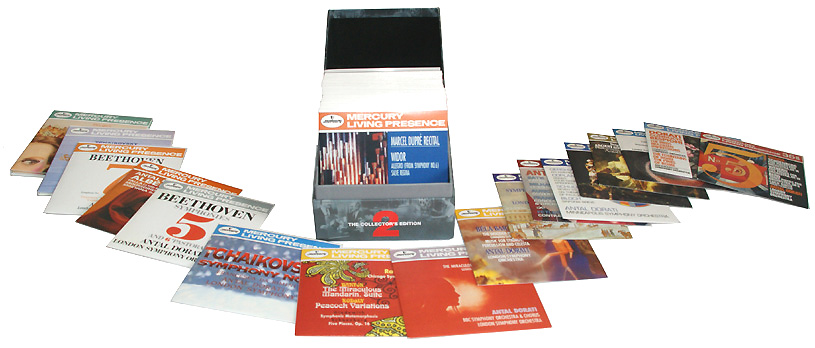
NEW MIX Wilma Cozart Fine has transferred over 200 Mercury tapes that date back from the years when analogue recording was an art as well as a science. She mixed the many legendary tapes to a DAT recorder from which the CD-masters were made. In order to make this possible it was necessary to restore the original recording and mixing equipment, Ampex 300-3 stereo tape recorders (using 1/2 inch tape) , the 35 mm Westrex machine, and the Western Electric mixing console. All were used at the end of the nineteen fifties and the beginning of the nineteen sixties, the early stereo days. The 35 mm film with the recording of Rachmaninoff's Piano Concerto No. 3 with Byron Janis and Antal Dorati was lost and a tape copy of this recording was used for the the LP issues and for the transfer to CD done by Wilma Cozart Fine. The first CD release does not have the 35 mm banner either. Apparently the 35 mm film recording was only discovered much later and was the basis for a new transfer to LP by Speakers Corner. Naturally the recorders and mixing console is valve-equipment. Although the transistor had been invented decades before, this was the only quality equipment available. In the process of restoring, not only the circuitry had to be checked, but the heads of the recorder should have the precise gap and should function with the right bias and equalization in order to read the signal to the max. The restoration of the equipment was not without difficulty. It took about six months to compete. The Ampex machines are special machines with three heads and three channels, with three head amplifiers. They were built specifically by Ampex for Bob Fine. EARLY EXPERIMENTS Wilma
Cozart Fine: "Bob handed the specifications to Ampex. You know,
he was a technician and an inventor. Already in 1955 he experimented
and compared the
quality of 2 and 3-track stereo. He said that only recordings made with
3 channels could provide a good stereo-image." |
|
|
Making the first stereo recording in 1955. Picture taken at a recording session of the Detroit Symphony Orchestra in Orchestra Hall (former Church of our Prayer). In the foreground at right is David Hall (producer) conferring with Howard Herrington (orchestra manager). Also in the foreground are instrumentalists (violinists, and a cellist) tuning their instruments and warming up. In
this first stereo setup three Neumann U-47 microphones were used and
it looks as if they were arranged in the configuration of the "Decca
microphone tree". However the microphone in the middle was independent
and was for recording in mono on a separate tape recorder with 1/4"
tape. Another recorder with reels with 1/2 inch tape was used for
stereo.
This
and similar experiments finally led to the typical microphone placement
used by the Mercury team in the days of recording classical music
in stereo.
(Image submitted by Peter Dobkin Hall.) |
One of the earliest proofs of Bob Fine's stereo technique is on CD as well. It is Mercury 432 005-2 with Zoltán Kodály's 'Hary Janos Suite', 'Dances of Galanta' and 'Maroszek Dances', and Bartok's 'Hungarian Sketches' and 'Romanian Folk Dances', all performed by the Minneapolis Symphony Orchestra conducted by Antal Dorati. The recording date: November 1956!
However, Bob Fine's stereo recording is unique because of the use of three microphones and the specific placement to record the performance on three tracks (channels) in order to fully capture the original orchestral balance. UNIQUE So a stereo-recording is only then true to life if the sound stage is picked-up by three microphones. This means in case of an orchestra, one microphone for the left section, one for the right section and one for the players sitting right in the middle in front of you. DIGITAL RECORDINGS AND 3 MICROPHONES I read on the internet a discussion between technicians telling that they were using this basic setup but were not pleased with the result. They concluded that the original 3-microphone setup has its flaws. They forget that the digital format of 16 bit and 44.1 kHz. sampling frequency is completely different from analog. Yes, the digital format has a dynamic range of 96 dB and also a signal to noise ratio of 96 dB. RESOLUTION Despite
the fact that analog formats have a S/N ratio somewhere in the region
of 80 dB or even lower, the resolution is much higher if compared to
the CD. The digital format of the CD is a linear format where with decreasing
recording level the resolution is decreasing as well. CLOSE-UP Many
modern recordings are made by close miking of all the sections of an
orchestra, a band or an ensemble. Many technicians understandably do
use more than the three channels used by the Mercury team. Today they
are likely to use 24 channels for recordings of large orchestras and
will adjust the various channels for obtaining the original orchestral
balance and will monitor the balance of the sound meticulously. Check
what is the difference between the linear format and a high resolution
digital format here: There
you can also read about the analog approach (miking)
in the early days when technicians started recording in the digital
format. |


 On a few pages
short examples of music will start playing automatically after the
download is ready, but only if Microsoft Internet Explorer is your
browser. Mozilla Firefox, Safari, and Google Chrome do not have the
facility to let you hear sound in the background.
On a few pages
short examples of music will start playing automatically after the
download is ready, but only if Microsoft Internet Explorer is your
browser. Mozilla Firefox, Safari, and Google Chrome do not have the
facility to let you hear sound in the background.

 In the summer of 1950 Wilma Cozart accepted
a positon with Mercury, as is stated in many articles.
In the summer of 1950 Wilma Cozart accepted
a positon with Mercury, as is stated in many articles. 


1/2 Inch and 35 MM Sound Recording
|
|


Everest, Command and Cameo
|
.
|
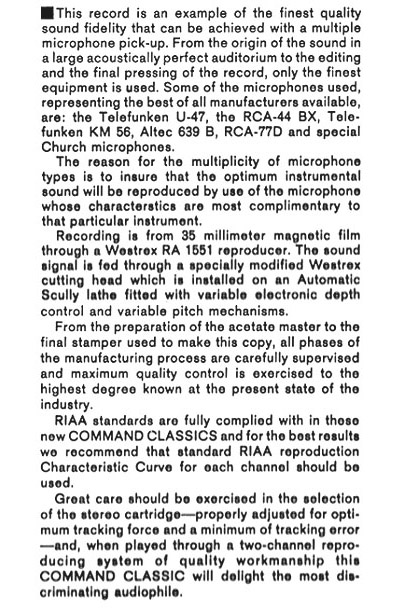
35 MM SOUND FILM CHARACTERISTIC That
same Byron Janis CD with Pictures At An Exhibition carries two encores.
One of them is recorded on the 35 mm film recorder made by Westrex.
Westrex had modified the machine mechanically and electronically to
Robert C. Fine's specifications, in such a way that three heads were
aligned and three channels with electronics were built in. Certainly
inspired by the Cinemascope and Widescreen movie technique which for
their sound recording used 5 tracks on the film. In the movie theater
there were 3 speakers in the front (left, middle and right) and there
were two speakers in the back of the theater and some supporting speakers
on the side walls. Since dialogues in movie theaters have to be understood, originally these film recorders had a frequency-characteristic that could not be identified as high fidelity. So they had to be modified in order to achieve the desired characteristics: an extended frequency range and perfect linearity, with the benefit of an increased signal to noise ratio of the 35 mm sound film. If
this correction is not made, the sound on LP gets that slightly "glassy"
character as often heard in Everest recordings. EVEREST Everest
initially used 35 mm film for recording and explained the advantages
on the inner sleeves: thicker tape, less print-through, wider tracks,
higher dynamics. These
differences are caused by the choice of microphones and microphone placement.
There are also the differences in the electronics of mixers and amplifiers
used when cutting a lacquer. These are: frequency characteristics, signal
to noise ratio, dynamic capabilities, phase characteristics, and distortion
values. Remember: Bob Fine had the recording characteristics of the
35 mm machines changed by Ampex.
COMMAND
Command recordings however have fantastic
sound because of the application of exact the same microphones, the
perfect placement of the microphones, and the electronics for microphones,
recorder, and cutting lathe. NOISE REDUCTION Often
these differences are also brought about by the unfortunate application
of the Dolby Noise Reduction System. Mercury did not use a noise reduction
system. C. Robert Fine had the electronics of his 35 mm recorders modified for recording music in high fidelity. To what extend Bert Whyte had already corrected the characteristic is not known to me. |




 |
|
 |
|
|
|
|
|

The Scully Lathe - Margin Control

|
||
 |


Taken from the cover of Bert Whyte's AUDIO Magazine, October 1970 Edition
Splicing the Takes
|

|
|


Microphone Placement
 |
||
|
||
|
||
 |
||
|
|
||
 |
||
|


|
.
|
|
The Transfer to CD
|
The
Mercury team used a Scully variable-pitch recording lathe designed by
John J. Scully
|


|
Early Stereo Catalog
|
OVER 'But
the CD's are closer to the masters, the original tapes, than the LP's.' DYNAMICS Many
a music lover did not like the stereo LP too well in the beginning.
They knew that there was something wrong with the overall characteristic,
even when big loudspeakers with large woofers were connected. MORE I
could have talked with Wilma Cozart Fine (who became a vice president
of Mercury records in 1954 until her departure a short time after Philips
had taken over the label) about many more subjects and details.
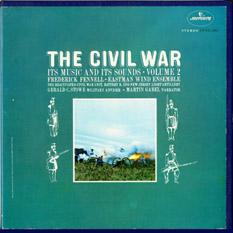
For instance about their journey to Russia and the recordings they made there with Byron Janis, conductor and violinist Rudolf Barshai, and pianist Vasso Devetzi; and the ones made in England for Philips with pianist Sviatoslav Richter and conductor Kyril Kondrashin. About conductor Antal Dorati, a pupil of Zoltan Kodály, about Dorati's Hungarian programs and the always and everywhere emerging 'Pictures At An Exhibition' on many different labels (on an early Philips Minigroove as well). About Frederic Fennell and the spectacular recordings of 'The Civil War', a sonic documentary about this dramatic and decisive episode in American history for which recordings authentic instruments were used (LPS2-901) with the Eastman Wind Ensemble conducted by Frederick Fennell, with Martin Gabel (narrator) and Gerald C. Stowe (military advisor). |
|


|
|
SPECIAL PROJECTS And
about the clear 'ringing' of bells and the thunder of canons in 'Overture
1812' of which the first recording in mono in 1954 (MG 50054) did not
make its entrance unnoticed, and that the recorded stereo version of
1958 (SR 90054) fully showed the strong points of Mercury's stereo recording-technique
and microphone placement. By 1963 over one million, and by the end of
the nineteen nineties two million, copies had been sold of this recording
(the photograph shows conductor Antal Dorati receiving his golden record
in 1963).
On the occasion of the two millionth copy a special box, the size of the LP, containing the CD-transfer, facts about the Mercury label and the recording, plus a DIY field gun was issued by Philips in Baarn (The Netherlands) in a limited edition. We
could have talked about the French programs (Ravel and Debussy) of conductor
Paul Paray. About how the valve equipment was kept on the right temperature
- when the recording van was parked in a cold garage - in order to provide
the same sound quality at all times. Tubes do need at least one hour warming
up time. They also need a near constant temperature to function well -
as we all know. About the financial success and the decline of the label.
About the jazz recordings which also had a special sound quality, but
then different microphone placements were used. About the recordings made
in London's Watford Hall. About the fact that later re-released recordings
were well transfered to a master tape first from which the lacquer was
cut. And so on. |
|
|
EARLY STEREO CATALOG RENUMBERED In
the September 1958 edition of Schwann Long Playing Record Catalog the
record industry introduced the stereo format of the LP for the first time
ever. The listings reveal that the presence of Mercury stereo recordings
is somewhat pale. Stereo recordings with Robert Fine and the recording
team, though certainly in the making, are not yet ready for release. SR 90001 - Johan Halvorsen's Suite Ancienne Op. 31 (written to the Memory of Ludvig Holberg) with conductor Oivin Fjeldstad. SR 90002 - Compositions by David Johansen (Pan Symphonic Music Op. 22); Edvard Braeien (Concerto Overture); Arne Eggen (Olaf Liljekrans); Jensen (Partita Sinfonica "The drover"); Sparre Olson (Two Edda Songs); with Odd Grüner-Hegge conducting. SR 90004 - Johan Svendsen (Symphony No. 2, Norwegian Rhapsodies Nos. 2 and 3), Oiven Fjeldstadt and Odd Grüner-Hegge conducting. These must be very rare records.
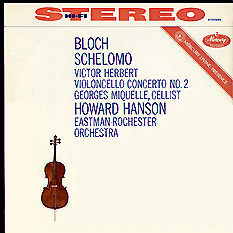
SR 90001 with a Bizet Program (Suites from Carmen and l'Arlesienne) instead of the music of Halvorsen. SR 90002 now contains Gershwin's Concerto in F and Rhapsody in Blue performed by pianist Eugene List and Howard Hanson conducting the Eastman-Rochester Orchestra instead of music by Norwegian composers.
Ravel's Bolero was originally a popular release on Mercury 18031, together with Rimsky-Korsakov's Capriccio Italien; Paul Paray conducting the Detroit Symphony. But as of November 1958 that recording is listed as SR 90005 coupled with Ma Mère L'Oye and Chabrier's Bourrées; no doubt a better coupling commercially; in any case for the classical collector. However, SR 90004 with the music of Johan Svendsen, remains for some time in the catalog. NEW STEREO RECORDINGS The catalog is expanding rapidly. The advertisement at left announces an important recording issued in a box with reference number SR-3-9000. It is a 3-record set, with Cherubini's Medea featuring Maria Callas, and conducted by Tulio Serafin. The mono set of this 1957 recording (originally done for Ricordi in Italy) had already been listed earlier. The stereo-set is available in March 1959 in the US on Mercury. The recording is licensed to EMI since Mercury had an agreement with this British giant. EMI releases the complete opera recording some 8 months later, in December 1959, on Columbia SAX 2290-2. The mono edition was already available in March on 33CX 1618-20. |


| The first single classical LP album was MG 10000 with the Russian recording of David Oistrakh playing Aram Khachaturian's Violin Concerto with Alexander Gauk conducting, originally released on 78 RPM on the SSSR label (CCCP in cyrillic). |
|
|
PHILIPS "Philips Phonografische Industrie" (PPI) and "Philips Gloeilampenfabrieken Eindhoven" could not operate on the US market as the American brand name Philco could suffer from Philips and Philips Company. Industrial products were therefor handled by "North American Electronics Company" ever since 1954. To sell records on the American market it was too costly to set up a distribution network, hire sales representatives, build a pressing plant and have an advertising department. But the main reason for not operating on US soil were the trade restrictions that existed between the USA and many countries. They were there to protect American interest and those of other countries. If the US would not permit foreign companies to establish themselves on the US market, than US firms had difficulty to operate in Europe. The only thing to do was to sign a contract with an American company. For Philips records the company to have a contract with was Columbia Records Inc. Since 1954 Philips had an agreement with Columbia Broadcasting System (CBS) who also owned the Epic label. Now most original Philips recordings were released on the Epic label and a few on Columbia. To begin with Columbia recordings were released on the European continent by Philips. AMERICAN COLUMBIA AND BRITISH COLUMBIA When
American Columbia and British Columbia had split, the American Columbia
recordings were no longer available in the UK and were now issued
on the Philips label in the United Kingdom. |
|
|
MERCURY Now the people from Dutch Philips were looking an independent record company in the US that had all the necessary facilities. In 1961 they bought Mercury Records Inc. That resulted in the appearance of many a Mercury-artist on the Philips-label outside the USA (violinist Henryk Szeryng, guitarists The Romeros, harpsichordist Raphael Puyana, violoncellist Janos Starker). Many a Mercury-tape was released as a Philips product. Several sound recordings made in Europe by Philips appeared in the nineteen sixties in the US on the newly acquired Mercury-label: pianists Clara Haskil (Mozart) and Cor de Groot (Rachmaninoff), in simulated stereo, and singer Gérard Souzay, while recordings of Van Beinum and Grumiaux continued to be issued on the Epic label, though Haskil with Beethoven appeared on American Philips. It was all rather confusing. But it showed that the acquisition of the Mercury label was probably an incentive for the Philips record company to make recordings on a much larger scale than before and on an international level. ELECTRICAL MUSICAL INDUSTRIES EMI The contract of Mercury with EMI in Great Britain, Germany and other European countries expired in 1963. That was an inconvenience. By 1965 Mercury records had disappeared completely from the British market. Only a selection of Mercury recordings were released in Great Britain on the Philips label whereas in Europe the Mercury label continued to exist and many records were pressed by Philips and several subsidiaries from Dutch matrixes (and in some cases from matrixes made in Chicago by George Piros with PFR written in the dead wax, P for Philips). They were of course pressed in factories in the Netherlands (Baarn), Germany and France. |
|


 |
MARKETING Now that Philips had settled in the US, Philips products could be marketed as Mercury products like the simple and affordable, plastic, monaural phonograph (gramophone) and a more luxurious stereo record changer also with built-in amplifier and loudspeakers as advertized on 12 inch inner sleeves of Mercury pressings. |
|
EMI IN THE NETHERLANDS In
Europe many a Mercury taped performance was first issued on the Dutch
and French Mercury labels. They were later reissued in the Philips 839
series and by 1969 on the Fontana label. Some ten years afterwards a
new series of Mercury-records were pressed in the Netherlands on high
grade low noise (silent) vinyl from new, Dutch plates, the covers were
adorned with a special gold seal stating 'Golden Imports', specifically
pressed for the US market where the Mercury label continued to exist
for some time. 60 YEARS MERCURY LIVING PRESENCE Originally I gave this page the title "50 Years Living Presence". That was in 2001 when this page was first published. Now it is more than ten years later and the heading should read accordingly. MESSENGER In
1967 the last recording by Mercury technicians was made and Mercury Living
Presence became history. But after so many years Wilma Cozart Fine gave
new life to the 'Living Presence' recordings. |

|

|
|
ON SEPARATE PAGES:
 |
 |
 |
Notes
|
|
|
|
|
|