|
|
|
|
 |
 |
|
| Thanks to hosting company ARVIXE, my pages are in disarray. Arvixe moved the server from Texas to Provo, Utah without warning and without providing the necessary codes, password and server address. We certainly hope that the inconvenience to you, the visitor, will gradually end as the pages are now hosted in the Netherlands. |
|
|
|
Ortofon
Moving Coil Phono Cartridge
|
 |
 |
 |
 |
|
 |
 |

|
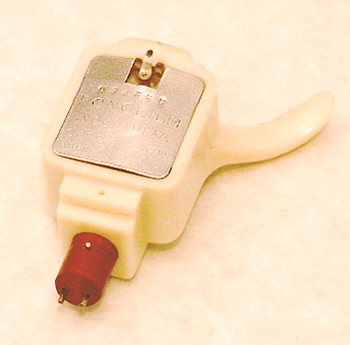
Above:
The Principle of the First Ortofon Moving Coil |
|
|
|
|
|
|
The
Moving Coil Principle
|
|
 |
 |
 |
 |
 |
|
|
Ortfon
SL15/SL-15 Cartridge
|
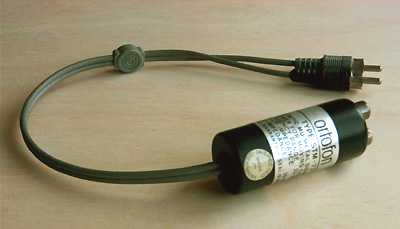
Ortofon SL 15 ELL is a further development of the Ortofon SL15 cartridge from around 1968 and had a beautiful step up transformer to match the impedance of the cartridge (2 Ohms) and the output impedance of 15 kOhm to connect perfectly well to the input impedance (load impedance) of 47 kOhm of the (pre-)amplifier. (These two images courtesy Don Sellers, USA).
These cartridges were replaced by the SL15, SQ 15 in the days of Quadro, and later by MC20 and MC10, before the 2000 and 7000 were introduced.
Below is the paper with the most important specs. Significant is that the electrodynamic system has a "flat" (velocity versus frequency) response, irrespective of the load.
|
|
|
Garrard
GMC5 Cartridge
|
|
|
|
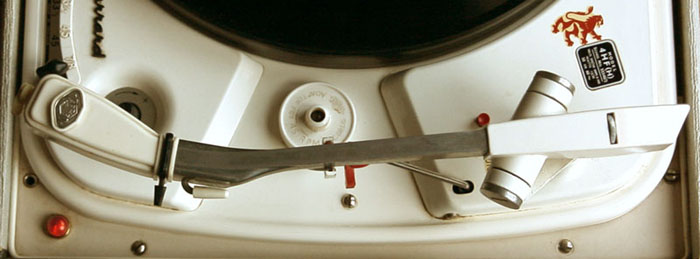
Garrard
TPA 12 Transcription Arm
|
 |
|
|
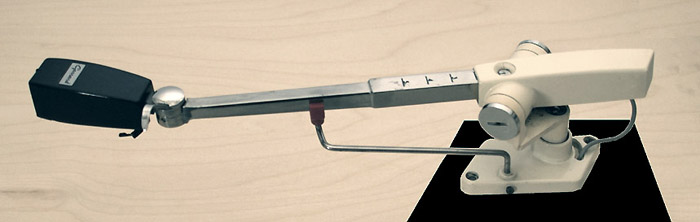
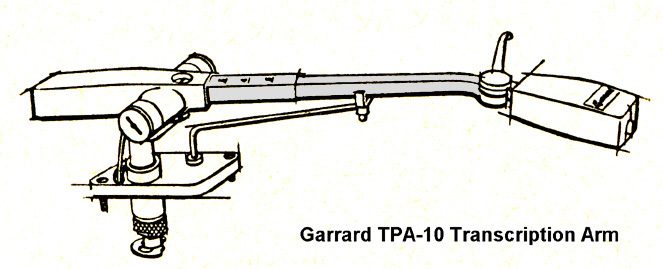
Garrard
TPA 10 Transcription Arm
|
|

|
DECCA
Moving Iron Pick Up Cartridge
|
Different
|
 |
 |
|
|
The
Decca London Configuration
|
 |
|
|
|
 |
 |
|
|
|
|
DECCA
International Arm
|
|
|
|
|
|
TANNOY
Variable Reluctance Phono Cartridge
|
|
 |
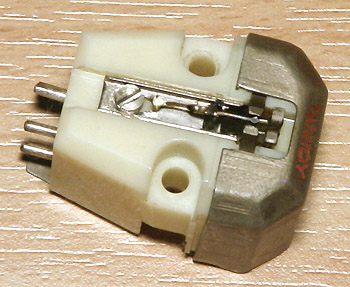 |
Tannoy also manufactured a turnover model of the Variluctance cartridge with "Complidex" stylus assembly.
|
|
General
Electric: Record Filter,
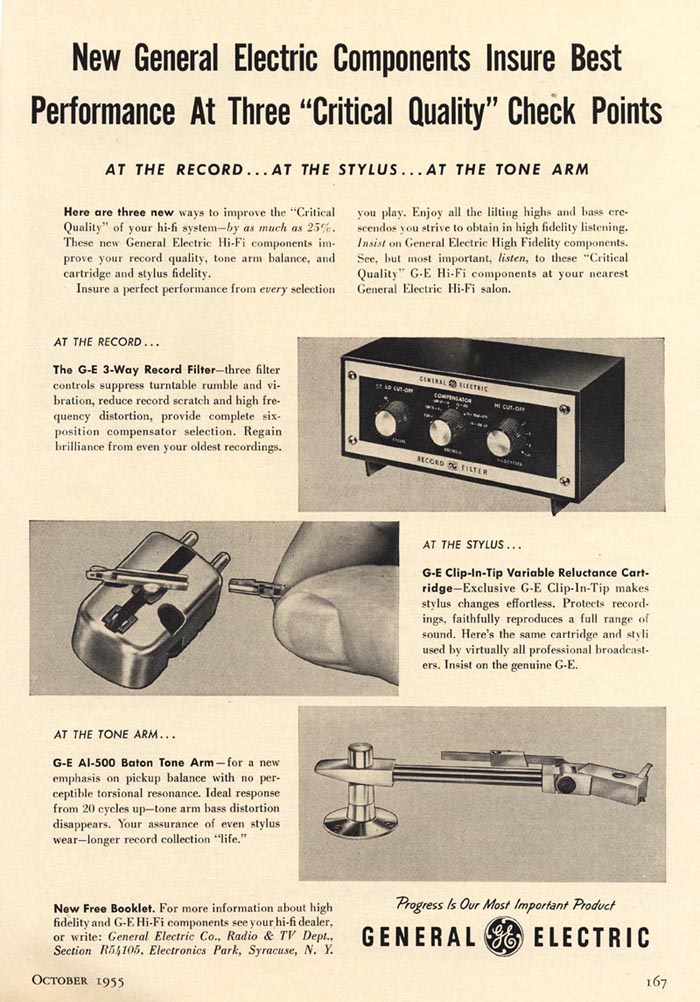
Clip-In-Tip, Al-500 Arm |
|
|
Modern
Days
|
|
R.A.B.
November 12, 2004 and updated since.
Images and specific drawings by Rudolf A. Bruil
Cartridges acquired from the collection of the late Jan Th. Endenburg
and the late Karl Föllmi from the Netherlands.
Home | Audio & Music Bulletin | LP List |
Record Cleaning Service | The Record Stabilizing Ring |
50 Years Mercury Living Presence | Turntable Adjustment |
Sound Fountain
|
|
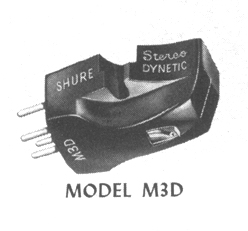
 Some
10 years ago I had a short correspondence with a Dutchman who
migrated to the US in the mid 1950s. He had designed a moving
magnet cartridge that was patented, but Philips did not want
to manufacture cartridges along this priciple as they had their
gramophone players equiped with ceramic transducers. Then -
according to this former Philips-engineer - he left the company
and migrated to the USA (as many Dutch people did at the time).
Then Shure studied his patented design, made a few alterations
to avoid patent infringement and started producing moving magnet
cartridges.
Some
10 years ago I had a short correspondence with a Dutchman who
migrated to the US in the mid 1950s. He had designed a moving
magnet cartridge that was patented, but Philips did not want
to manufacture cartridges along this priciple as they had their
gramophone players equiped with ceramic transducers. Then -
according to this former Philips-engineer - he left the company
and migrated to the USA (as many Dutch people did at the time).
Then Shure studied his patented design, made a few alterations
to avoid patent infringement and started producing moving magnet
cartridges.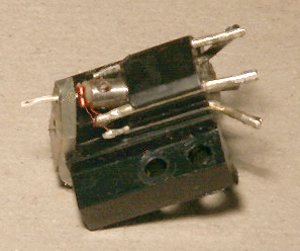




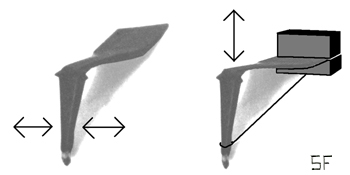
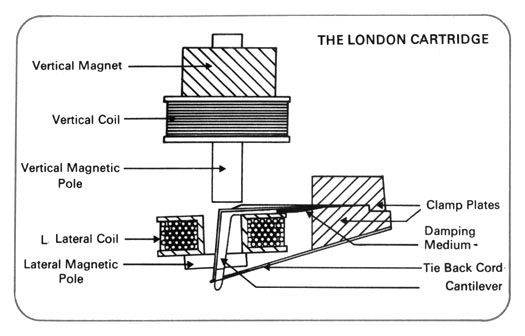
 The
design of the Full Frequency Stereo Sound (ffss) cartridge uses
two pairs of magnets and three coils. One magnet for the pole
pieces of the two 'vertical' coils (the drawing supplied
by Decca shows only one coil). And there are magnets placed left
and right of the single lateral coil for generating the
lateral movement of the armature.
The
design of the Full Frequency Stereo Sound (ffss) cartridge uses
two pairs of magnets and three coils. One magnet for the pole
pieces of the two 'vertical' coils (the drawing supplied
by Decca shows only one coil). And there are magnets placed left
and right of the single lateral coil for generating the
lateral movement of the armature.
 It
would have been theoretically logical if for the vertical movement
just one coil would have been used and placed around the horizontal
part of the bent iron cantilever which is parallel to the record's
surface. This would mean that the coil with a magnet had to be
positioned farther away and closer to the clamp holding the garrote
in order to leave ample room for the lateral coils. In that configuration
the parallel part of the iron needed to be much longer, in fact
too long. The Positive Scanning (as the Decca engineers called
the working of their design) would not have been possible.
It
would have been theoretically logical if for the vertical movement
just one coil would have been used and placed around the horizontal
part of the bent iron cantilever which is parallel to the record's
surface. This would mean that the coil with a magnet had to be
positioned farther away and closer to the clamp holding the garrote
in order to leave ample room for the lateral coils. In that configuration
the parallel part of the iron needed to be much longer, in fact
too long. The Positive Scanning (as the Decca engineers called
the working of their design) would not have been possible.