History: 25 Years CD Ortofon, Garrard, Decca, Tannoy The Sound of Tubes and Transistors
Your Desert Island Discs Lp Cleaning & DIY Cleaning Formula Elisabeth Lugt Soprano Active Loudspeaker System
Turntable & Cartridge Adjustment Marie-Claire Alain, Organist Phono Cartridge Optimizing
The Universal Stabilizing Ring SACD: Upsampling & Noiseshaping Decca London Ribbon HF Loudspeaker Gold for Bernard Haitink
DIY: Turntable Weight/Clamp The Joy of Well Positioned Speakers Rabco SL-8E Tangential Tonearm
URSR: Review in HiFi World LP Lists Vintage Equipment Mercury Living Presence Records
URSR: Picture Gallery The Long Playing Record Guide HiFi Tunes: DAS KLASSIKERBUCH
The TD124 page The SP10 Page DIY:Tonearm Building
Joachim Bung: Swiss Precision Stefano Pasini: German Perfection The Bullet Plug
Mengelberg's St. Matthew Passion Plinth for Technics SP-10 mk2 Record Shops in Amsterdam Violinist/Violist Paul Godwin
Paris Jazz The Sound of The Turntable Mat Acoustic Revive R77 Generator The Remington Site
CLASSIQUE 777 Lp Record Covers How to Correct WARPED Records   Mercury Recordings on Fontana
SOUND FOUNTAIN

hobbyists's views for hobbyists
Record Cleaning Machines - KM - Loricraft - DIY Liquid - Storage

© Rudolf A. Bruil - Page first published on the www on November 3rd, 1999


Using the Keith Monks Record Cleaning Machine,
the Loricraft PRC, the Knosti/Disco Antistat, do the cleaning by hand, or construct an effective and safe cleaning
device yourself...

CHOOSE A TOPIC BY CLICKING ON A BUTTON

CLICK
CLICK
CLICK
CLICK: DIY FORMULA
CLICK: HOW TO USE TURPENTINE
CLICK: CLEANING ALBUM COVERS....
CLICK: SPINDLE HOLE TOO NARROW?
CLICK: WHAT SLEEVES? ... CLICK: REPAIRING COVERS
CLICK: DIY CABINETS FOR STORING


...

.. CLICK: SKIP THE INFO AND START CLEANING

My Keith Monks Record Cleaning Machine has cleaned over 20.000 records.
That is more than 40.000 sides. Not counting the many thousands
of records the previous owner must have cleaned with this machine.
As a hobbyist and collector I offer to clean records to other collectors.

CHOOSE ANOTHER TOPIC

 
Professional Record Cleaning For Hobbyists.
I have spoken to many record collectors. What struck me was that many have invested in cartridges of $2000 and even $3000 or $7000. But they do not own a proper record cleaning machine.
If you are new to the game, or your record collection is growing, you better invest in a Keith Monks or a Loricraft first and then start saving for the esoteric cartridge and phono cables.

I have also overheard talk (and have read comments) of collectors who think that cleaning a record for longer than two turns is a waist of time. Do they have to catch a train?
An important aspect of listening to analog sound is that the actual engraved signal should be as good as can be. The actual signal is far more important than tape hiss, the noise of the vinyl or a few ticks.

There is much you can do to improve the signal by using a Stabilizing Weight, a Stabilizing Ring, a better cable... but most important is cleaning the record first and removing the debris (which has been collected during many years of use) out of the groove. Or clean a new record as well to discover its full sound potential.

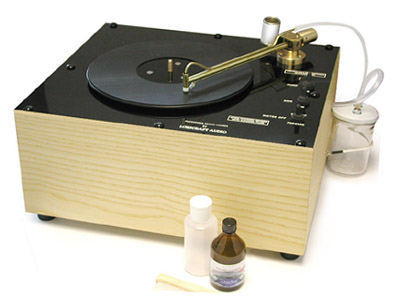
The Keith Monks Record Cleaning Machine is one of the world's best devices for cleaning records and keeping them in excellent condition.
The Loricraft Record Cleaning Machines (PRC) work along the same principle devised by the late Percy Wilson, but they omit the stationary brush and the motorized unwinding of the buffer thread. The advantage is that the Loricraft machines are about half the price of the Keith Monks.
With both brands extraordinary results can be obtained if an effective cleaning solution is used. Not only dirty records can improve, but also many old records from the vintage era and from the early days of mono can successfully be cleaned and regain in many cases a lot of their former splendor.

Do Newly Pressed Records Need Cleaning?
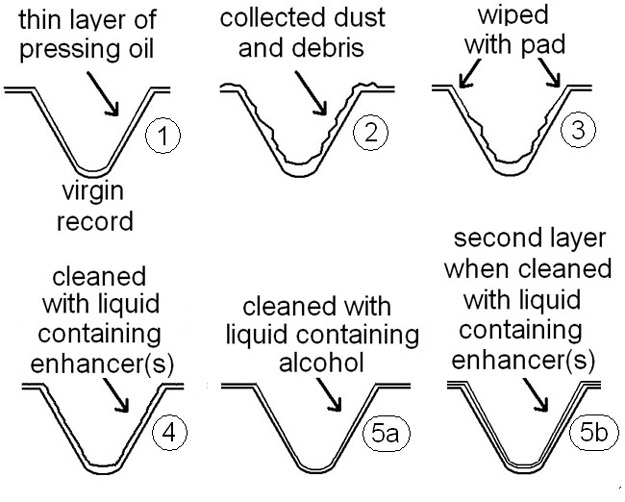
Definitely YES! Also newly pressed records can be cleaned so the residue left in the groove, the pressing oil/fat included, will be eliminated. New does not always mean clean!
Recently a complete set of Haydn Trios (completely new) was offered to a friend and we discovered that the sound was not as clear as on the Philips set I own. After cleaning the records thoroughly, the piano had its defined sound and the string instruments now sounded harmonious and refined.

My tip: Never buy a sealed Lp (record in a sealed cover). "Factory sealed" does not necessarily mean "impeccable". There is no guarantee the disc is MINT. You may come home and open the blister and be surprised: thin vinyl, small scuffs, badly pressed vinyl, etc. And what will the seller answer when you tell him that the record you bought from him was not OK? When I am in a shop and see a sealed record, I ask the attendant or shop owner to remove the plastic so we can check the surfaces together, or I just open the plastic myself so I can check the surfaces myself.

The cleaning liquid should have optimal proportions of distilled water, industrial alcohol and the exact number of drops of an industrial detergent or a very good (pure) washing detergent. (NOTE: For cleaning 78 RPM shellac records never use alcohol but just distilled water. Go to the specialist's web sites)
Not every cleaning liquid on the market will give maximum results.
There are several well known commercial record cleaning formulas from different manufacture that contain some sort of grease in order to put a thin layer/film of grease over the surface of the Lp. The aim is to let the diamond tip glide easily over the walls of the engraved vinyl groove. It should be a very thin film though.

CHOOSE ANOTHER TOPIC

Professional Cleaners: To Grease or Not To Grease...
It is even better if the cleaning liquid does contain no grease at all. The molecular structure of fat can coincide with the size of tiny engravings of frequencies in the groove. More so it prevents the direct contact of the stylus with the groove wall.
Playing a completely clean groove will even out very tiny holes in the vinyl as the needle tip reaches a high temperature (900 to 1200 degrees Celsius) and that for a very short time when riding the groove. And that is an effect which is appreciated by many vinyl lovers. It goes without saying that the needle tip should be clean and dry as well. You can use the same cleaning formula. Apply it with a soft brush first and than clean the actual diamond tip with the special LAST brush.

Furthermore the grease (or whatever additive is used by manufacturers of special liquids) smoothes out the information in the mid band and the mid-high register as if the tiny diamond tip is skipping some information. The effect is that the attack and the transient response are somewhat hampered.
Also the application of special, more or less volatile, liquids which put a thin layer between needle tip and vinyl groove can have this effect: the high frequencies are sounding "nicer and refined", but the attack of instruments can be less clear. A problem with these liquids is also that they are not easily applied evenly on the record's surface.

Only after cleaning the completely dry record has been played entirely, the cleaning with grease containing liquid or one of those special liquids like LAST's Record Preservative can be applied, only of course if you really want to! Because it can depend on the record. Some fierce sounding Mercury LPs sound much better with Record Preservative. You yourself have to judge whether you use such a product on all records.

Improving the Signal by Playing and Washing.

You can play a record immediately after a wash. However it is better to wait some time (an hour) before playing the record. After a day the record will sound even better. It is important that the vinyl is completely dry. The molecular water drops should have evaporated completely. The vinyl should regain its hard structure.
If you give the record a second wash after playing, you will notice that the signal will improve even further. An extra improvement can be obtained by playing the record once again but now with a spherical diamond tip, and then wash the record again.
The grease prevents this improvement. Do not forget that the engravings are mere micrometers. The improvement is hardly or not at all reached when using a Knosti / Disco Antistat basin, as only vacuuming the surfaces will rid the groove of dirt and grease completely. And you should know that if the groove of a second hand record is severely damaged, because the previous owner played it with a worn needle, than only slight improvement can be reached.

CHOOSE ANOTHER TOPIC

The System: Brush, Thread and Pump.

Keith Monks's ingenious machine cleans the record by applying the cleaning liquid via brushes on the record which is spinning at about 80 RPM. Dirt and grease will gradually be solved and will float in the liquid.
A vacuum pump which is connected to the special arm will suck the record completely dry. The Loricraft PRC omits the motor which releases the thread from the spool. But the Loricraft is less costly.

In order not to damage the record a thread acts as a buffer between the record's surface and the white teflon nozzle at the end of the arm. The drawing shows its functioning. The unwinding nylon thread from below is guided through a thin copper tube to the end of the arm. There it is inserted into the white teflon nozzle. Together with the dirty cleaning liquid, the thread ois transported by the suction of the pump and lands in the jar with discarded cleaning liquid. The suction arm is driven by a belt and moves slowly, starting at the label and moving towards the periphery of the record.

What Thread?

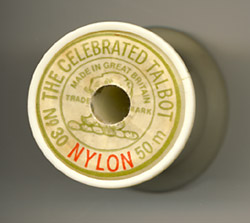
The best option for a buffer thread is the nylon thread as it was originally used by Keith Monks. It came from England and was The Celebrated Talbot No. 30. Not solid but the braided type. This make is no longer available. Many owners of Keith Monks and of Loricraft machines have been experimenting to find a solution.
Polyester is not the best alternative, but always better than polyester mixed with cotton as cotton absorbs the liquid and expands and this obstructs the suction. At one time I used a thin thread of polyester doubled, wound on an old spool with an electric drill. It works fine.
Doing some experiments can do no harm. Always try on an old record as with some threads the vinyl can be damaged. The best option is to find a manufacturer of nylon thread or just ask Keith Monks or Loricraft.

After the First Wash.
After the first wash, I apply -if necessary- a special cleaning liquid with a brush, by hand. This only if persistent grease (sometimes even glue) and other properties, need to be solved and removed. After that the record is cleaned on the Keith Monks Machine for a second time. Records cleaned in this way will sound even better. A clean record will extend the life of the record and of the needle tip of the cartridge and will increase realism and will increase your listening pleasure.

A groove pictured before and after, images taken from the Keith Monks literature. Photo by Mr. Aalt Jouk van den Hul.

As with all equipment the effectiveness depends on its functioning. Therefore technical insight in its functioning, cleaning the brushes once in a while, emptying the containers in time, and finally mixing the best ingredients to obtain an effective cleaning liquid, these are all essential for the machine to deliver the best performance and give the best sonic results. I have a lot of experience regarding the cleaning of records. Do not hesitate to send me an e-mail if you want advice.

There are many record cleaning machines on the market. The Loricraft cleaning machine works along the same principle as the Keith Monks and is very effective and also less expensive than the Keith Monks. The VPI and Clearaudio have similarities and do work very well. They do not have a suction arm which moves from label to periphery, but have a long pipe with a slot which is put over the record and sucks the liquid and dirt in just in one or two turns of the record. The Nitty Gritty machines follow the same principle. Zenn Audio in Singapore proposes a fast centrifugal cleaning machine (without dry suction via a vacuum pump). Recently a small machine is available on the market. It is the Cadence Okki Nokki. The platter, motor and pump seem to be sturdy and well working, though the pump is loud, but check carefully if you like the suction arm which has some rough felt around the mouth and could damage your vinyl. In my view that part should be improved and be made safer for your records.

CHOOSE ANOTHER TOPIC

The Simplest DIY Vacuum Cleaning Machine.

The simplest DIY Cleaning Machine consists of a sturdy record player (Lenco or Goldring) that can play at high speed (78 to 80 RPM), a nylon brush, a carefully constructed mouth piece with soft lining, a glass jar with screwable lid, plastic transparent tube, and an old vacuum cleaner or other effective pump. See to it that the hoses (tubes) are not too wide but have a reduced capacity so that the liquid does not enter the vacuum cleaner. Brushing at high speed and vacuuming at a low, convenient speed.

This is a simple way to clean records by hand and rinse them under the tap. Take care that the labels do not get soaked and damaged. This method is generally not advised as it leaves minerals and chemicals in the groove. However, it can be a first step when you need to clean records which are covered by colonies of mold (mould).


CHOOSE ANOTHER TOPIC

Do You Own a Record Cleaning Machine and
Want to Improve its Functioning?

Maybe you can learn from some of the improvements I made on the Keith Monks Record Cleaning Machine.

1. Locate the machine in a separate room, an attic or in a (dry) garage.

2. Build a cabinet to place the machine on. Calculate the height of the cabinet in such a way that you can easily put a record on the platter without damaging it.

3. Build a roof over the machine. Make a hole in the center and add a ventilator with an exhaust pipe The pipe should end in a hole in the outside wall, door or window

4. Take the vacuum pump out of the Keith Monks Machine's cabinet and place it on a wooden base and decouple it with springs. Buy extra lengths of tube and wire to connect the pump.

5. Mount to the left and right of the ventilator small 25 or 40 Watt bulbs. You can connect the lamps and the ventilator to the same switch so both will function when you are cleaning records.

6. Buy a new belt and improve the drying of the record. The suction arm should move slowly from the center of the record to the periphery. Many users complain about the fact that the arm skips a few grooves and leaves some liquid on the record's surface. The best thing to do is to use a new arm belt that you can buy at a camera repair shop where they also sell belts for movie projectors. Take the old belt with you and ask for a similar new one. In most cases they cannot supply a belt with the same thickness but just smaller. That will do the trick. Now the arm will move slower and will not skip part of the record. Of course drying will take a bit more time. But who cares if one has a valuable record collection. So many times I read in threads and lists that a virtue of this or that machine is that it cleans in just X seconds. I do not understand those people. What is it that you want? Saving 30 seconds? Just do not start cleaning a record when you have to catch a train.

7. Check the functioning of the vacuum pump. Check the pump from time to time and clean the innards carefully and put everything back the same way you took the various parts out before you started to clean the pump.

The result is:

a. The exhaust prevents you from being exposed to the cleaning liquid which contains a high percentage of alcohol.

b. Because the pump has been placed underneath the machine and on springs, the machine does not vibrate and the platter turns in a silent way without the suction arm being moved by the vibrations. The effect is a smooth and even drying of the record.

c. The record is cleaner and it is also completely dry.

CHOOSE ANOTHER TOPIC

KM Machine Repair?

If you own a Keith Monks Record Cleaning Machine and there is some problem with one or more of the functions of the machine, related to the pump, the suction arm, the thread or the small liquid pump, you can contact the firm on the Keith Monks website. The service of the firm is rather bad. Maybe you have to improvise. Furthermore the prices of the spare parts are relatively high. You better look for alternatives first. First of all for the nylon thread. The thread which is sold today is not the thread which Keith Monks used to sell to owners. The new thread is thin and deteriorates. Better find an alternative. And if you do not find what you need in local stores, you still can contact the manufacturer of the machine in England.
A new belt, for example, can be obtained from a camera repair shop which sells all sorts of belts for movie projectors and tape recorders. Or you can find a company on the Internet like Elexatelier in the US.

If you have a machine which uses the Lenco/Goldring variable drive and you need a new idler wheel, you can try to find one of the Lenco turntables second hand and remove the idler wheel plus attachment and mount it in your KMRCM. Or again you can try the Internet. There are addresses where you can have an idler wheel made to your specifications by sending the existing wheel and they will refurbish it.
It is not surprising that some day the toggle switches do not work properly any longer, especially when you have cleaned 20.000 records (40.000 record sides). Various machines use different toggle switches in different configurations. Make a drawing of the existing wiring before disconnecting the switches and exchange them for new one. They should of course work exactly the same way.

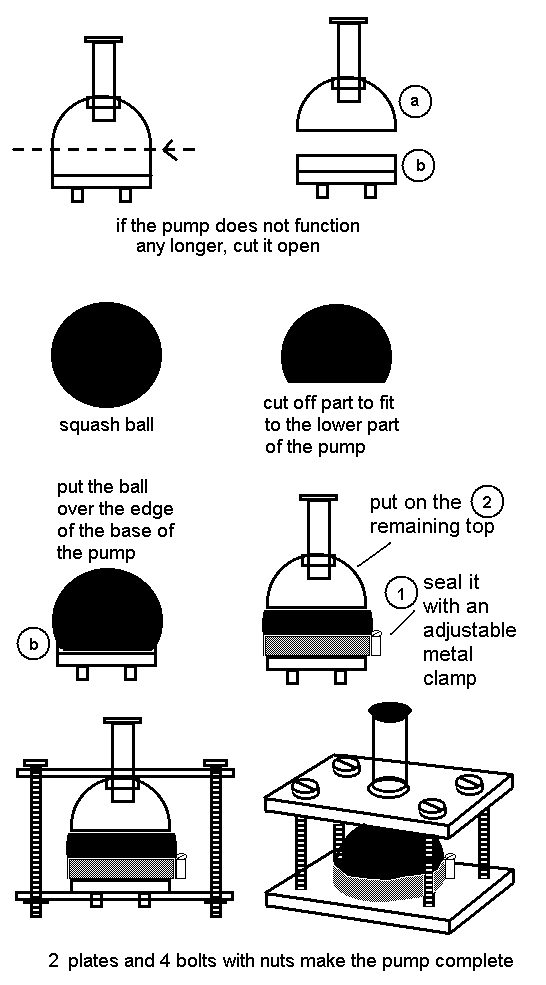
If the liquid pump does not work any longer you can reconstruct a pump by using the parts of the original pump (choke), or search for a hand pump or some device you can use or construct the hand pump(s) from. Or make something similar as the drawings tell you when it is necessary to repair/reconstruct the existing small pumps.

If you want to repair the vacuum pump, than you have to be ingenious and find a way to replace plungers, rubber rings and make the small round "valves" yourself.
If you need a new pump, you can contact the representative of knf.com (KNF Neuberger, Germany). I recently bought the KNF N022ANE. It is the pump in this image.

CHOOSE ANOTHER TOPIC

Second Hand Machines?
When buying a second hand Keith Monks Record Cleaning Machine you have to pay attention to a few important points. You must check if the pump is working and if it is not, you probably can detect what the trouble is. If the pump does not function at all and is irreparable, you should order a new pump with a similar capacity.
Next question when examining a second hand machine: Does the motor for the movement (rotation) of the arm work all right? If not, can you detect the cause? Maybe it is the belt. Or the little motor does not work at all. Then it probably should be replaced.
There is a third small motor for the unwinding of the nylon thread. If you do not know about the working or the value of the machine offered, you can mail me.
Keith Monks manufactured the twin machine shown at the beginning of this page and there is also the single machine. At one time a smaller, somewhat less desirable (in my view) machine was manufactured (picture at the right). Only if you can obtain that machine for just a few $$$, it is an option. You probably will use the parts and built these into a new cabinet which makes cleaning easier than the machine shown in the picture at right suggests.

CHOOSE ANOTHER TOPIC

Make Your Own Cleaning Liquid.

Here is the formula which I used for several years:


2 liter distilled water
1 liter alcohol
1/2 liter isopropyl alcohol
20 to 30 drops of liquid detergent

The number of drops depends on the effectivity of the washing detergent.
Some washing detergents have lower values for ionic and non-ionic tensides.
Or use PhotoFlo (or a similar substance) what the photographers apply. See PhotoNet where PhotoFlo is discussed and compared to a washing detergent.

The alcohol should be of the industrial kind without any additive. This alcohol is cheaper than the medicinal type bought in the pharmacy which contains a small percentage of fat and is called 'spiritus ketonatus fortior'. Let yourself be advised by experts from the art supply shop or the paint shop. Take care because the isopropyl is very poisonous; you need ventilation.
And this to the satisfaction also from the friends who bring their records for cleaning.
If you cannot find the fat free alcohol, you may use the 'spiritus ketonatus fortior' type which is always less greasy than some commercial record cleaners with greasing additives. The addition of isopropyl is specifically advised if you cannot find the fat free alcohol. Be sure that the distilled water is really distilled water, the type you buy at the pharmacy, not the demineralized water!
Note: Never use a glass cleaner or other aggressive product.

Use a large plastic container that is big enough to hold 4 to 5 liter. First put in the contents of two bottles (2 liters) of distilled water and add the drops of detergent. Shake very well. Than add 1 liter of the alcohol and if you wish a little bit of the isopropyl alcohol. And again shake very, very well. By shaking the container, the liquids will mix well and the detergent will foam. After you have stopped shaking the foam will go away after about 5 to 10 seconds. If it goes away immediately you probably have not added enough detergent. You will notice this when you put the liquid on the spinning record on the cleaning machine: the liquid does not spread evenly. So, add a few more drops more and shake again. But be careful not to put too much detergent.

Many years ago a knowledgeable analog friend from Germany gave me a small bottle of betain. It says "Betain Z" on the label and it is from Spinnrad. Betain is a form of hydrochloride acid substance and makes the cleaning formula foam as described above and acts as a surface tension releaser. 16 to 20 drops for 3 liters of liquid (2x distilled water 1x ethanol) will be enough.
Many formulas work with the Keith Monks machine. You can try whatever combination of ingredients and eventually adjust the formula according to your experience and the audible results you obtain. You can leave out the isopropyl altogether if you wish.

In general one wash will be sufficient to clean a record side. The result depends also on the time you leave the record spinning under the brushes. If you use a Keith Monks or Loricraft, the time of the brushing of a record side should be about the same as the time it takes to dry one side.
If you use a different machine do take some time to brush the record. Do not forget to keep the record wet all the time while cleaning!


CHOOSE ANOTHER TOPIC

Playing Wet.
It is possible to play records wet with distilled water. It will lower surface noise during play. At the same time however the movement of the tip is somewhat reduced also. But that does not impair the sound too much.
What is important however if you play records wet, it is necessary to dry the record before putting it back into the sleeve and cover. It is better to clean the record after wet play. So that is where your vacuum cleaning machine comes in handy.
Playing wet is quite a hassle. Playing records using a special liquid like Lenco Clean (cleaning solution) is even more complicated and because of the viscosity of the liquid will impair the transient in the signal. There will be a reduced attack in the the drum, the cymbal, the piano and other percussion instruments. I strongly advise against the use of Lenco Clean or similar product. There are other solutions to arrive at a reduced noise floor and a more controlled signal. Try a Record Stabilizer Weight or a Stabilizing Ring.

CHOOSE ANOTHER TOPIC

The Use of Turpentine and Sticker Remover: Stickers, Glue, Dirt.
Do not believe the so called expert who advises you to use a window or glass cleaner, or a bathtub product to remove dirt from the record's surface. Never use these products. Also do not use solvents, thinners, etc. for removing paint, glue or whatever is sticking to the vinyl.
There are only a few liquids that you can safely use: industrial alcohol, methylated spirit and turpentine.
Especially turpentine is useful for removing stickers (if you do not use a commercial sticker remover from the chemist's), and for dissolving and removing glue or a drop of paint stuck to the precious record.
What to do?
Go to the art supply shop and buy a brush. I use the Royal Talens 6 - 350. It is a relatively soft brush, but the hairs are sturdy enough to rub against any glue or drop of paint, or whatever is on the vinyl and needs to be dissolved and removed.
For removing stickers: dip the brush in turpentine, press the hairs against the bottle's opening to remove excess liquid and wet the sticker on the record cover with the brush. Leave it for several minutes. Then you can try to pull at a corner of the sticker and see if it detaches. If not, apply some turpentine again and let the sticker soak. It may be necessary to use just a little bit of force. But be careful! If the sticker can be taken off, the cover will show some residue. Just brush that spot once more and then use a paper tissue to wipe off the rest of the turpentine, sticker and glue. If a stickers is put over another sticker, you will have to repeat the procedure for each sticker.
There are stickers that do not soak up the turpentine because the surface is not porous, as is the case with "golden" stickers. These cannot be removed with any liquid and need some warm air from a hair dryer or should be held carefully over an open fire (stove). If it does not work, leave the sticker on.
Also be careful if you want to use turpentine on very old printed cardboard/Kraft covers, because it may dissolve and smear the old printing ink.
Turpentine can be safely used on laminated covers and actually most modern covers. If some of the turpentine is soaked up by the Kraft, cardboard or paper, just leave it, it will eventually vaporize. Turntable
can of course be used on vinyl also. It is however greasy and you should clean the record very thoroughly again after serpentine has been applied.
I recently acquired a few first pressings of a vintage label. They had been advertised as being un played and unopened. However three of the five albums had been opened and glue of the sticker was smeared on the vinyl over a wide area. There turpentine possibly could help. I soaked the brush in the turpentine and gently moved the brush over the large spot and let it soak. After a while I moved the brush again over the area, always parallel to the groove, waited again and repeated the action. The glue was dissolving gradually and nicely, and I could wipe it off with a tissue. After that of course I applied turpentine once again. All residue had to be dissolved and removed. This has to be done carefully and with patience. But the reward can be that the record surface will be neat and the groove can be played again, only of course after a few cleanings on the machine.

Another disc had a sort of debris in circles stuck to a wide area. I was not sure whether this could be removed or if it was not vinyl grain and the groove was really damaged by playing it with a worn needle. The only way to be sure was to apply turpentine with the brush. Again I moved the brush in circles. Very gently. Than waited some time and with the brush I could take off the residue of the pressing which was made 50 years ago. And finally I could use the tissue to soak up the rest of the turpentine. After that the disc needed two cleanings on the machine. Surfaces of the other discs were also showing some residue -they were first pressings that never had been played- and before cleaning the record on the machine it was the turpentine that helped.

That is why I generally do not buy factory sealed records. I only buy them if I know I can trust the seller and the record can be returned. 'Factory sealed' is definitely no guarantee that they are MINT. Actually they can be less than pristine. In some cases even the seller may shrink-wrap the item.

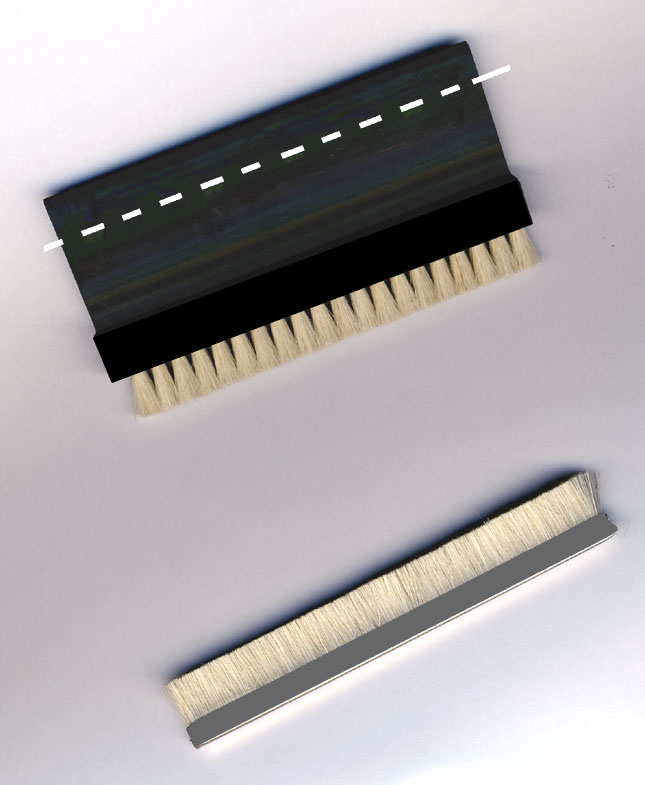
NOTE: Always remember: Before cleaning a record on the cleaning machine, in the basin, or by hand, do always clean the record with a carbon fiber brush and if necessary with a soft velvet record brush before wetting and/or spinning the record. Get rid of all the dust and debris without applying force. And if this advice and these methods are new to you and you want to be sure that they work, try it first on an 'old' record. Once you have learned what you can and what you cannot do, you can start treating your precious discs.

CHOOSE ANOTHER TOPIC

Removing Stickers from Labels and Albums.
If there are stickers on the record label, I would advise you to leave them there and not to manipulate them, because the situation only can get worse. But if you insist...
Removing stickers can be done by using a special sticker remover, a solution which can be found in the drugstore or a specialized shop with office or art materials. You better try the effectiveness of this liquid on a dispensable record/record cover. Sometimes a label is easily damaged. Apply the liquid and let the sticker soak for some time. Then carefully try to lift the sticker at a corner. If it is not detachable, do apply some more liquid and take more time.

You can combine this method with the use of a hairdryer. Place a high cardboard roll (the basis of a wide packaging tape) on the label, around the sticker. Do not position the roll over the dead wax or over the groove. Now hold the hairdryer over/in the opening of the roll and blow hot air for a few seconds inside the roll. Check if the sticker can be lifted at the edge. Do this carefully. Then blow again for 5 seconds. Try to remove the sticker a bit more. Etc. You probably can also try the hairdryer method without the use of the sticker remover solution if it damages the color of the label. But that can be a dangerous affair.
The special sticker remover liquid can probably also be used for removing ink. Try again on a dispensable record. I can not give you a brand name of the sticker remover as every country has a different brand name and probably a different composition of the liquid.
Also remember that I am not responsible for any accident or damage of a record or label. Always let the record cool down gradually, never put a "hot" record or record label under the cold tap.

CHOOSE ANOTHER TOPIC

Does Cleaning Damage The Vinyl?
Some people claim that cleaning a vinyl record will damage the groove. Somebody wrote in a forum that he had talked to people from a record company and these people said that a record should not be cleaned with liquids. Understandably they say that. They want that vinyl records sound mediocre, so the CD will be more appreciated and the new SACD will count on new enthusiasts who have enough of bad sounding, romantically cracking records.
Only in a few cases the record groove can be damaged. That is the case when a record (typically a dj single) has been played extensively with a bad needle. Cleaning the record can deteriorate the groove a bit further which in effect was already damaged. Also if the vinyl was not heated during the pressing procedure, the groove can be rough and is not poshed enough. The cleaning can have a more or less negative effect. It is also possible that low grade vinyl has been used. These cases are very rare though.

There is much turbulence going on when a stylus follows the groove. A record can collect small particles of dust and gets dirty. Before playing a record it needs to be wiped gently with a soft velvet brush or one of these special carbon fiber brushes. Naturally these are only effective if the record's surface is relatively clean. If the record is not brushed, the dust will stay on the record and will be pressed into the groove by the high temperature the stylus tip generates when riding the walls.
The climate in the listening room has its influence also. Heavy smokers should not be invited. Smoking is not advised. The record can collect greasy particles which float in the air.
Not carefully slipping the record in its sleeve after play will increase the possibility that it gets dirty.
And as said earlier: the use of grease/oil in the pressing process is a necessity to separate the matrix from the ready vinyl record. But the residue hardens when the record cools off. This hardened grease can give a ticking sound or a sound as if there is a bump or other unevenness in the vinyl. Especially in the nineteen seventies the application of the pressing oil or fat was not always done carefully. Many buyers and also the personal in the shop thought that the records were damaged and traded them in and send them back to the factory.

The only remedy for all the inconveniences is cleaning the record with cleaning solutions that are safe. The cleaning solutions advised on this page will help you to restore the quality of many a new and old record.
Cleaning damages the vinyl? When did you stop washing your hair?

Only in extremely rare cases a groove can be damaged by the cleaning process. The cause is not the cleaning machine with its brushes, it is not the cleaning solution, the high speed or whatever aspect of the technique of the machine. The cause is the vinyl itself, or to be more precise the time and temperature applied during the pressing of the vinyl. If the vinyl pancake is not heated enough and not heated during a sufficient time, the vinyl will not flow and attain its glossy surface. Especially when pressing 180 gr. vinyl records it can be possible that the vinyl is still somewhat raw so to speak. In very rare cases it is possible that by cleaning such a record with nylon brushes the surface suffers from the action. Do not blame this effect on the machine if you have maintained clean brushes and do use the cleaning solution which has proven to be effective and safe.

CHOOSE ANOTHER TOPIC

Is it Possible to Repair a Seam Split?
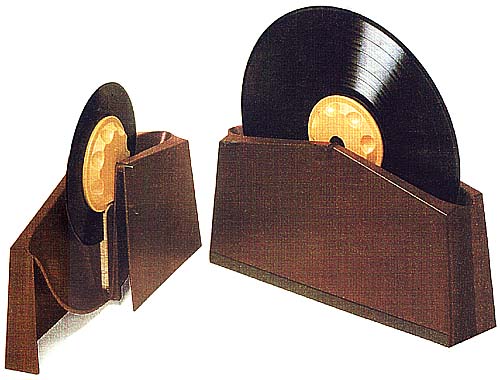
Seam splits are a nuisance. They can get longer and longer and they can damage the record if the inner sleeve is not new and does not protect the rim of the record. The drawings show what can be done. Of course, it is not easy. But if you are handy, you will experience here too that practice can make perfect.
Take a long piece of 200 gr. paper or Kraft. The length should be a little more than the split. Fold it along its length. See to it that the paper stays folded. If you want to make it last forever you can cover it entirely with a piece of wide transparent adhesive tape. Then fold it again. Now cut the piece more or less to the needed size. Fold it again, so it will better remember the fold. Spread it out on an old newspaper and then put on the glue and smear it out.
Now comes the difficult part and that is slipping the piece into the inside of the cover. You can bend the cover somewhat and than put the piece in place. If you can get some help it will make things easier. Clamp the seem for some time.
This method works best with covers made of thin cardboard or Kraft. For sturdy, thick cardboard you could probably fold the piece that you want to insert over the edge of a ruler and than carefully move the ruler to the desired spot.
If the entire seem is split it is best to open the cover and make two long strips as described above. Glue these to one inside and press. Add glue to the other part and press the front cover to the new seem. Clamp again for some time.

CHOOSE ANOTHER TOPIC

What if You don't have a Vacuum Machine?

This cleaning formula works also very well when using the DISCO ANTISTAT (Knosti) device, as friends and collectors have told me, and some have shown me. If you find the right balance of the ingredients you will notice that there will be hardly any residue, hence not much dirt does accumulate on the needle tip when first playing a record cleaned with this ingenious device.
To eliminate the residue to the max you should use a second basin (brushes included) just filled with distilled(!) water and rinse the disc after being washed in the first basin.

Do not think that by a few turns the record groove is well cleaned. As on a Keith Monks the record turns for about a minute, you should turn the record in the Disco Antistat quite for some time. Here again your experience will tell you if the wash is too short or is effective.

Since isopropyl can cause leakage of the vinyl (as I am told), you should avoid cleaning with just isopropyl. But you can use it in a mix. Just add a few percent to your formula. However the Library of Congress once proposed a mixture of 20% isopropyl and 80% de-ionized water. I tried that solution and it worked all right But the isopropyl is toxic. In this case building an exhaust is even more urgent. However, I have returned to my original formula. And, surprise: The Library of Congress have devised a new formula which I did not try yet, but looks rather promising viewing its ingredients.

CHOOSE ANOTHER TOPIC

The First Step

Whatever machine or cleaning device you use, it is important to take dust and other particles off the record before you start cleaning it with a liquid. If you use a Keith Monks or other high speed machine, put the record on the platter of the machine or on the platter of an old turntable like a Goldring/Lenco (which you may have installed for this purpose) with the B-side facing up. Then switch the machine on and dust the record with a carbon fiber record brush. Stop the spinning. Turn the record so that Side A is facing up. Dust off this side.

If the record does not have rough particles, dirt and dust, you may start the liquid cleaning process. Always put enough liquid on the surface and spread it around before spinning the platter. The liquid will prevent the record from being damaged by any left particles. If you start cleaning now, you will automatically do Side A first. And then Side B. So you will not get confused.

Another important thing is to clean the brush(es) of your cleaning machine at regular intervals. Dirt may stick to the brush(es) and eventually will harm the groove.

In case the dirt is really sticking to the vinyl and cannot be taken off with the carbon fiber brush, than you will have to gently clean the record under the tap first and dry it carefully with soft paper tissues. Do not exercise pressure and do not smear the tap water plus dirt over the record's surface, nor its label. Once you are satisfied with the result and have dried the surfaces with tissue paper you may start cleaning the record on the machine.

If dirt, glue and other unknown materials were not removed from the disc by the cleaning process, you can try other liquids like turpentine, benzene and methylated spirit for removing persistent dirt. These liquids will generally do no harm to the vinyl. Use a small brush to apply the liquid and give the liquid time to do its job. In certain cases you also may use cotton tips. After the dirt has been removed a paper tissue will absorb excess liquid. Then the record can be cleaned again. In case of the turpentine you may clean it more than once, or add an extra drop of washing detergent.

CHOOSE ANOTHER TOPIC

The Spindle Hole Diameter.

Some turntables have rather large spindles. And some records have spindle holes which are too narrow. Most of the time it is the paper label which is pressed at the edge into the spindle hole of the record.

You can 'create' your own spindle hole widener. Buy a pair of small kitchen scissors with blades that are about 8 mm wide in the middle at the pivot (screw). Cut off one eye. Now you can fold the blades so that they shift further over each other. The cutting edges are now at the outside. Fold the two blade together so that they fit into the spindle hole.

Take the record in one hand and with the other you put the scissors blades into the hole. The blades will always adjust to the size of the spindle hole. Gently turn the scissors. The amount of pressure you apply will determine the extend of widening the spindle hole. In most cases a few light turns at one side will do.

Take care that the debris (paper, vinyl) is taken off the record. Do it with your finger. You can turn one finger nail in the hole and flatten/clean the edge and blow the debris away. Try if the record fits on the turntable without having to apply force. If it does not fit give the scissors another light turn.

I have been using this method for many years and it provides an even widening. This is to my knowledge the best way to go about and will give good results. Most of the time it is not the vinyl which is obstructing, but the edge of the paper label that will prevent the record hole to slide over the spindle.


CHOOSE ANOTHER TOPIC

Inner Sleeves.
After thoroughly cleaning the record, I put it in a new sleeve. Certain inner sleeves like the ones from Decca, London, Deutsche Grammophon and Philips can be very cautiously cleaned with a paper tissue and a few drops of methylated spirit. It takes some practice. In general though I use a new inner sleeve and slip the original one (if it has text and/or pictures) into the cover as well.

To avoid mold caused by humidity and to avoid sticking of plastic to the surface Philips used inner sleeves of thin, soft blotting paper, just a folded sheet, no glue, no flip back borders. That was in the 1950's. That was an excellent practice. Later the blotting paper was replaced by folded sheets of white paper, and for the more expensive series the sleeves were made of paper sealed inside plastic bags.
If you have 10" records without inner sleeves you can make these yourself by choosing a nice quality of coated paper, fold it and cut it to the right measurements so it will just fit into the 10" cover.

There are various inner sleeves available on the market and to my knowledge the ones manufactured today are of the not sticking kind. Also most sleeves from the nineteen seventies and eighties are of the right kind. The sleeves will not stick to the surface if both the record. Keep the sleeve clean. Do not use Lenco Clean or other fluids on your records when you play them. These liquids will put a thin film of sticky liquid on the record and on the inner sleeve, as you may have noticed. On top of that Lenco Clean restricts the movement of the needle tip and not only diminishes high frequency information and kills an excellent transient response. And the transient is just one of those valuable features of the analog Lp which the CD cannot perform at all because of its restricted bandwidth.

If you want to play wet, than a preferred method is using distilled water. In all cases it is of importance that you clean the record on a cleaning machine after it has been played wet or at least see to it that the surface is completely dry before you put the Lp back into the inner sleeve.

The quality of the sleeve is of the utmost importance. If you have very old records with sturdy cardboard covers that hardly allow you to insert a modern polylined paper sleeve, you could use the simple plastic Nagaoka variety of inner sleeves. The Nagaoka inner sleeves do slip easily into the old nineteen fifties/sixties cardboard covers. Be careful though. They are thin and with the record inside, they also slip easily out of your hand. It is far better to use the square double lined all plastic inner sleeves as used by Proac, Soundstream, and others.

For records from the nineteen seventies and eighties the modern polylined paper sleeves are excellent. They are less expensive.


My pages do generate a lot of traffic for which additional bandwidth has to be bought.
If you like the advice and it was useful to you?

CHOOSE ANOTHER TOPIC

Record Storage: LPs and 7 inch 45 RPM discs.

Many visitors of my pages do ask me about how to store their valuable records. There are various sites dealing with this subject. There is also advice from the Library of Congress who in 1959 published a research paper on the life expectancy of acetates, vinyl records and tapes. The conclusion was that records could maintain their quality for over a century and even tape had a rather long life if taken care of storage and maintenance.

Now, many decades later, one can only agree with the finding that records can have a very long life, provided humidity is kept relatively low, the room temperature is not too high (preferably under 35 degrees or even lower), records are kept out of the sun and heating sources can not radiate directly on the albums, and the records should be stored vertically and do not have room/space to bend. In hot climates they should be stored in a room on the north side of the house/apartment, and the shelves should have doors or venetian blinds. Rooms should have curtains.

Why keep records for more than one hundred years? Well, the Lp has the extraordinary feature that its signal always can be reproduced because the information in the groove is analogous and has to be read with a mechanical device. One wonders if a century from now the CD still can be auditioned.
You have all the interest in keeping your records in good shape for at least as long as you live and as long as you will be able to play them.

To protect old, valuable albums and also gatefold editions, I use outer sleeves of transparent plastic. I use the thick variety which is supple, not the hard kind. There is also a thinner, less sturdy transparent outer sleeve available. The records are slipped into the sleeve from the top. This makes it possible to store the album and pull it out of the cabinet entirely without leaving the album on the shelve and holding just the plastic outer sleeve in your hand.

Some collectors have thousands and thousands of records.
The most efficient and cheapest way to construct shelves and cupboards is by using plasticized/plastic coated chipboard of 30 cm/12 inches wide.
Make compartments of 33 cm wide, 33 cm high and 33 cm deep as you can see in the picture below and the following drawings.


Since the chipboard is only 30 cm (12 inches) wide (deep) you can glue/screw 3 cm of wooden strips to the outer panels facing the wall. Or you just have a wider chipboard and have it cut to the desired size of 33 cm or more.
You can construct your shelves also from MDF if you like. The plasticized chipboard however does not need primer and paint and the plastic layer is friendlier to the cover than the painted Medium Dense Fiber board is.
Instead of the vertical shelves you can make horizontal shelves on which other rows of horizontal shelves can be stacked if you collection is growing. You can build up to 6 rows of shelves. On the top you could place boxed sets of records.
These are all suggestions of course and may help you to reflect on the shelves you want to make yourself.

And if you are not handy or want to adept shelves to the available space in your listening room, you could opt for Ikea Bonde cases which present a practical and esthetic solution.

For 7"/45 RPM records also shelves can be constructed. But it can be a good idea to make containers of (birch) plywood, complete with a simple or luxurious grip. Long containers need extra reinforcement half way. The containers can be stacked and labeled.

I have a lot of experience regarding the cleaning of records. Do not hesitate to send me an e-mail if you want specific advice.

CHOOSE ANOTHER TOPIC

© Rudolf A. Bruil - Page first published on the www on November 3rd, 1999


Home | Audio & Music Bulletin | LP List | DIY Tonearm | Record Stabilizing Ring
The Remington Site | Links | DIY Record Weight-Stabilizer |
Rabco SL-8E Tonearm | Thorens TD 124 Page | Technics SP 10 Page

Sound Fountain

Audio&Music Bulletin - Rudolf A. Bruil, Editor - Copyright 1999-2006 by Rudolf A. Bruil and co-authors