 |
|
|
 |
 |
|
© Rudolf
A. Bruil - Page first published on the www on February 12, 2008.
Idler
Wheel Drive, Heavy TPA 12 Arm and Crystal Pick Up on 4HF and 5HF
Idler Wheel Drive and Crystal Pick Up on TA Mk4
 |
Garrard 5 HF At left you see an edited picture from an advertisement in a record collector's magazine from 1963. It is the beautifully designed Garrard 5 HF record player on a matching plinth. The turntable has 4 speeds: 16 2/3, 33 1/3, 45 and 78 RPM. According to the advertisement the platter weighs 2 kg. There is a knob at the front at right for adjusting the speed (+/- 5%) if there is a deviation. This facility is specifically important when playing old shellac records which were not always cut at 78 RPM, but at 80 RPM or whatever speed the manufacturer of the early days adopted. The deck has a heavy arm, suitable for a ceramic or crystal pick up. But also low compliance moving magnet types of phono cartridges can be used. |
 |
The
TPA 12 Arm
Garrard's
own moving coil cartridge |
 |
Playing Weight There were two versions of the 4 HF. One was just a plain portable record player. The second version was a portable gramophone with amplification. The down force (playing weight) is not adjusted by sliding a counterweight but by increasing or decreasing the tension of a spring. On the short end of the arm is a slightly protruding wheel. If you turn it to the left the down force will be less and if you turn it to the right the playing weight will be increased. |
 |
Portable Mono This is the mono edition of the Music Master. The lid contains 2 loudspeaker units. One for the low and mid frequencies and one for the high frequencies. There are three potentiometers. At left is the knob for setting the volume. The second from left is for adjusting the treble. The third one controls the bass. |
 |
Portable Stereo This is the stereo version of the Music Master. It consists of two portable units. One consists of the two loudspeakers. The other has the turntable plus the lid. The built in amplifier of this portable gramophone has four knobs. The fourth is for adjusting the balance between left and right channel of course. The advertisement (from which the image at the left is taken) talked about four speakers. This certainly was meant to impress prospective buyers. More is better. In fact there were the two low-mid units and the two high frequency drivers. All these versions have the Garrard TPA 12 transcription arm. |
 |
For Old Mono Lp Recordings These
Garrard recordplayers have an automatic shut off which can be disabled
by pressing the small red button next to the arm base marked "non
automatic". |
|
78
RPM Fanatics Love This Machine Many
music lovers have evolved with the market and are used to listening
to stereo long playing records and to the Digital Audio Compact Disc.
A few have experienced the sound of 78 RPM direct to disc recordings
from before World War Two. No tape recorder was involved. A range of
cutting lathes were installed in ghe monitoring room or close to the
performers. |
 |
The British record magazine Disc (Vol. 4, No. 15, Autumn, 1950) explains the technical aspects of the new LP format and instructs its readers about playing weight (down force) which should not exceed 8 gr. mentions the sizes for styli, information which is crucial for the music listeners and collectors who have to get to know the LP record introduced in the UK and on the continent in 1950. To illustrate the difference between LP and 78 RPM shellac disc the author uses the format of the Decca record company. "In the L.P. record, the size of the groove has had to be very considerably reduced to permit the employment of a fine groove pitch. While its shape remains very much the same, its size is little more tan one-third that of the groove used for standard 78 r.p.m. recordings. Approximate dimensions of the two grooves are given in the (...) table and the diagram (...) gives a good indication of their relative size." |
 |
The writer continues: "One very important difference between the two types of recording concerns the recording characteristic adopted. In the Decca ffr recordings, this takes the form depicted by the dotted line in the (...) graph. The characteristic adopted for the L.P. record is very similar to the American N.A.B. lateral standard except for the low frequency end which does not conform to a true constant amplitude curve. The characteristic does in fact approximate very closely to that adopted by Columbia in America. This type of characteristic is ideally suited to microgroove recording as it avoids the excessive stylus amplitudes immediately above the cross-over frequency which are encountered with the constant amplitude/constant velocity curve." |
|
|
At
left record magazine Disc
Wide Range With
the advent of the Compact Disc many people started collecting vinyl
abundantly. And often they came accross old 78 RPM discs too and bought
a suitable gramophone to play them. That is what happened to me also.
There are various items worth listening to: Eduard van Beinum
conducting the Concertgebouw Orchestra in The Swan of Tuonela (Sibelius),
Herbert von Karajan with the same orchestra in Don Juan (Strauss),
Paul van Kempen with the Berlin Philharmonic (1936) performing
Les Preludes (Liszt), Withold Malcuzynski playing Chopin, Eileen
Joyce on Columbia, Mengelberg on Columbia, Emil Telmányi
on a 10" Tono, Ida Haendel with Wieniawski's Polonaise,
Yehudi Menuhin playing Mozart with his teacher |
 |
Demonstration Excellent
demonstration records are the already mentioned Barcarolle by pianist
Alexander Brailowsky (Polydor 35014, 1934), and Walter Gieseking
playing Variations Symphoniques (César Franck) with Sir Henry
Wood, on English Columbia. It is amazing how well the piano is recorded
and in balance with the orchestra. But also the early nineteen fifties
hits and jazz records - though not direct cuts (direct to disc) - have
a flabbergasting presence. |
 |
The Mechanism Even
after 50 years of dedicated service, the mechanism is still working
perfectly. (In due time I will add pictures of the 301 and 401 so a
comparison can be made between the 4 (5) HF and the legendary Garrard
transcription units.) |
  |
2-Way Loudspeaker System Simplicity
makes sense: a two way speaker system in a quasi open baffle. An oval
driver for the low and mid frequencies and a high frequency unit. The
addition of the back panel improves the dynamics and gives a good reproduction
of the low frequencies in relation to a firm mid band. |
 |
6 dB Slope For The Tweeter The high frequency unit is a sealed unit and is connected in parallel to the low-mid driver. Just one capacitor (electrolytic condenser) of 8 uF in series provides a 6 dB slope, ensuring a correct phase. Do not swap it for a polypropylene capacitor. You may loose some of the speed of the sound and the nice mid-band. And polypropylene will influence the dynamics and the frequency curve. |
|
|
A favorite position of the lid containing the speakers is in a corner on the bare floor. No carpet, no absorbing material. Just a hard floor and background. The harder the background (wood, tiles, wall), the better the detail and tangibility. Carpet and curtains as backgound will muffle the sound, kill transient response and decrease realism. Just adjust the distance between lid and walls to get the most harmonious sound and liveliness. |
 |
The Front-End is Important Choosing the best suitable ceramic cartridge or crystal pick up is of course important. Various makes do come to mind. Ronette and Acos are the best known. At left the Merul and at right a simple Ronette. |
 |
The Scale For the 301, 401, 4 and 5 HF, the Garrard engineers designed the SPG3 Stylus Pressure Gauge. It was packed in a small cardboard box with instructions. For todays standards with precise measuring of a cartridge's playing weight with a digital scale, the increments of 0.5 gram of the SPG3 result in a rather rough adjustment. In the early Lp days, playing weights of 4 to 10 gr. were possible. For 78 RPM shellac records a down force of 9 gr. can be necessary. In the case of shellac records the best down force is emperically found, as the Garrard scale's indication is 12 gr. maximum. For that a small brass weight of 5 gr. was supplied to calibrate the gauge. |
 |
The Strobe For users of the early 301, the 4HF and 5HF and also the TA Mk4, Garrard suplied a neat stroboscope for calibrating the correct speed in countries with 220 Volt/50 Hz. power. It was a "stroboscopic speed indicator", a small plasic disc of about 96 mm in diameter. It gave the exact speeds of 33 1/3, 45 and 78 RPM. Such a disc was necessary if the platter did not have strobiscopic markings and after the recommended 10 minutes run-in time the speed had to be calibrated anew. |


 |
 |
 |
And then there is the Garrard TA Mk 4
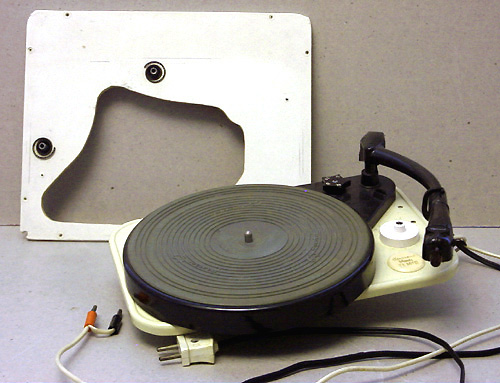 |
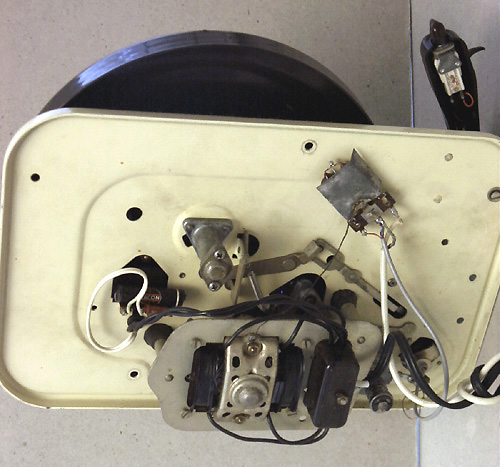
Garrard Ta Mk 4 The
Ta Mk 4 is a very ood turntable for playing 16 2/3, 33 1/3, 45 and
78 RPM records. Motor, platter and tonearm are in working order. This Garrard TA Mk 4 is for sale. Go to the conact page to mail me if you are interested.
|
 |
|
 |
