Different
Materials
At
first hearing a rubber mat will allow more detail, but you
may discover after a while that these are make believe refinements.
Peaks in the frequency curve should be avoided at all times. A relatively
hard mat is the best option: acrylic (Goldmund type), hard rubber
(the Technics SP-10mk2 type). The choice of mat should always be made
in relation to the turntable itself and the arm and cartridge combination.
Soft rubber, fluffy felt and very soft sorbothane are providing
just fantasy. It is like eating cake with too much cream. After
a while you get sick of it.
If
the sound is not detailed enough you should check if there is a mis
match of cartridge, arm, capacitance of the phono cable, and pre-amplifier.
In that case check this page first:  Phono Cartridge Optimizing
Not long ago I
bought a mat which was relatively thin (only 3 mm) and made of a rather
brittle material. Though it looked somewhat like acrylic on first
inspection, it emphasized the mid-high frequency band and did not
provide a good mid band. The difference between this quasi audiophile
mat (it was advertized as being audiophile) and the mat of the Technics
SP-10 Mk2 for example, could be heard when there were a few ticks.
These lacked the mid frequencies when the brittle mat covered the
platter. The audiophile mat weighed only 242 gr. while the Technics
mat was 4 mm thick, weighed 414 gr. The acrylic mat I currently use
is machined out of a 5 mm thick sheet. That mat weighs 402 gr. The
4 mm corian mat was 426 gr. There is abviously a relation of weight,
thicknes, and good sound.
History
In
the early days of the record era the gramophones which played the
78 RPM shellac discs generally had their platters covered with a velvet
fabric in nice green, black, red, brown or blue.
After the LP had arrived the rubber mat was introduced. At first it
was just a very thin rubber sheet with a circular pattern to cover
the platter. Rubber was used because it was a practical material.
It kept the grooves relatively free of dust, could be removed and
easily cleaned whereas velvet could contain dust and leave this behind
in the micro grooves of the vinyl.
In
time thicker rubber mats were used and audiophiles and manufacturers
discovered the differences in sound depending on the sort of rubber
and the difference related to a good contact between record and mat.
Technics,
Thorens, Nakamichi
In
the nineteen seventies designers of turntables started to listen even
more carefully to their products and many not only came up with a
heavier platter but also with specific turntable mats.
In Japan Technics used a not too thick mat on their SL-series
direct drive machines.
On the SP-10Mk2 a thicker mat made of hard rubber was used which contributed
to the straightforward and uncolored sound quality.

From
Japan were also the specifically shaped mats from Nakamichi similar
to the mat offered by Haraoka. These mats are made of hard
and heavy rubber which contains a relatively high percentage of metal.
And
there was also a thin mat from red copper, specifically shaped for
maximum support and close contact with the record. But such a mat
was easily bent.
Initially
the mats on Thorens turntables were not too good. The later versions
of TD-160 and TD-126, at the end of the nineteen seventies, had mats
which supported the record in a better way and on top of it they were
made of a harder rubber which contributed to a far more dynamic and
precise performance.
Spectra,
Audioref, Dumpa

In
France the Spectra turntable mat was introduced. It consisted
of 3 layers of different kinds of polymer, each with specific properties.
The surface provided a firm grip on the record because it was sort
of 'sticky'. A record was not easily lifted up. This mat provided
a remarkable transient response which was more situated in the upper
regions as with a felt mat than in the fundamental frequencies as
in harder rubber mats or the acrylic mats. The diameter of the Spectra
was too large, 300 mm instead of about 280 mm. Records with a thick
groove guard were not always optimally supported.
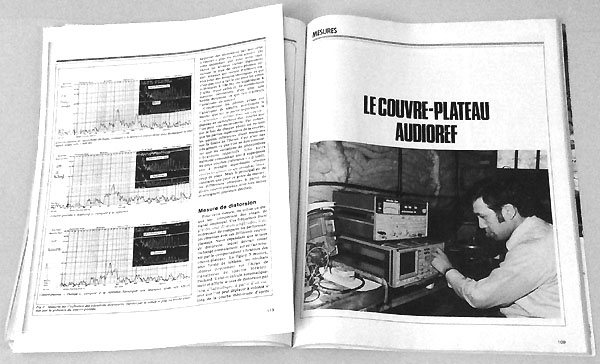
The
August-September 1980 edition of La nouvelle REVUE DU SON featured an
article written by Jean Hiraga who compared a hard rubber average turntable
mat (=couvre plateau) to the Audioref and Dumpa turntable mats, both
originally developped by Jean-Claude Fourrière, at the time owner
of Valois Distribution and designer of Audio Reference and Toltèque
loudspeaker systems.

The
Dumpa mat had an even better curve than the Audioref mat which was already
less interfering with the music's natural balance as engraved in the
record groove. Jean Hiraga, who has been a leading designer and audio
journalist for many deccades, appreciated by many audiophiles as well
as demanding music listeners is seen here doing the extensive measurements.
and evaluations of turntable mats. Many years later he produced his
own design with remarkable qualities.
You can read about it on the
TWOGOODEARS
website.
The
Spectra was superseded by the Audioref (marketed by Jean-Claude Fourrière
in the 1970's in France) and a later edition which he devised was
the Dumpa mat. It was made of harder rubber and made it less tricky
to remove the record.
It also had more neutral properties which translated in less coloration.
Measurements showed that rumble was several decibels compared to conventional
mats.

Not
only the rumble spectrum was many dB lower but now the curve also
had a regular pattern in the lower register which is the fundament
for a faithful reproduction of the many harmonics.
(Note: One could say that Jean Claude Fourrière knew what he
was doing. He was the designer of the incredible loudspeaker systems
named Audio Reference 800 which could boast on four 38 cm Audax woofers
(from the PR 38 series) per channel and yet the sound was as light
and fast that the most refined details and subtleties in the recording
were heard. Later he designed the Toltèque cold plasma loudspeakers
which would promise an even more transparent sound devoid of matter.)
Mission,
Ariston, Linn, Hiraoka, Oracle
In
the UK Farad Azima of Mission Electronics proposed a mat made
of sorbothane which was said to have excellent damping properties.
(Mission used sorbothane also in the 3 feet of their turntable. But
there it was apparent that the isolation from rack or other support
was not sufficient.) The properties gave an airy sound with a clear
upper midband but the attack still could be improved, specifically
in the mid band. Sorbothane was/is also used by Audioquest.
Mission's
mat prompted Ariston of England to produce a mat with a more
amorphous structure and different damping properties.

When
Linn originally started the production of the Linn Sondek LP12
a rubber mat was used for several years. It was a mat with a striped
profile. Later Linn discovered that the LP12 would project a more
tasteful sound and image with a felt mat. The first felt mat was relatively
thin and soft and as soon the accentuation of the high frequencies
was discovered, a thicker and "harder" felt mat was available
for the Sondek.
From
Japan came the Hiraoka mat, type SE 22 M, similar to the Nakamichi
mat. This is a very heavy and thick mat consisting of rubber with
a high content of metal. The mat promised to give a better damping
of the record and should provide a better stereo image, a cleaner
sound, and at the time could improve speed constancy of the platter.
 The Hiraoka mat is not supple but rather hard and over the years
its hardness may have become less friendly for the surface of the
vinyl record. If you are not careful, it can even scratch the surface
of the vinyl because the surface has a somewhat round shape and the
record shifts over the mat with ease.
The Hiraoka mat is not supple but rather hard and over the years
its hardness may have become less friendly for the surface of the
vinyl record. If you are not careful, it can even scratch the surface
of the vinyl because the surface has a somewhat round shape and the
record shifts over the mat with ease.
Another
interesting design was the mat which adorned the Oracle turntable.
It was used in conjunction with a clamp that had to be screwed on
the threaded spindle. The shape of the mat was slightly convex and
the record was clamped down in order to make a firm contact between
the surface of the record and the mat. This led to a more precise
signal and an improved transient response.
Mikro
Seiki Copper Mat
Micro
Seiki proposed a mat turned from copper, the CU-180, which could be
used on different turntables.
This mat could be covered with an additional mat of felt and this
would result in more or less the same sound pattern as was given by
the Linn LP12 turntable: detailed high frequencies, smooth and fast
mid section and transparent bass.
The
CU-180 could also be used with no additional mat and in that case
it would not only add weight to the existing platter, but also would
give a clear, no nonsense transient without any phase shift. In that
case more attention would have to be paid to the choice of cartridge
and arm combination and choice of phono cable.
The CU-180 was marketed for several years and was a gadget which was
appreciated by many a high end audio adept.
Goldmund,
Acrylic, Marantz, Nagaoka
Glass Mat, Corian
When
the Goldmund engineers designed their turntables (Studio, Studietto,
Reference) an acrylic platter was used in conjunction with a specially
designed clamp which consisted of different materials. They also made
a separate mat plus clamp available for audiophiles who wanted to
imitate more or less the 'Goldmund sound quality' with their existing
turntables.
|
|
|
A
DIY acrylic mat 28.8 cm in diameter. The center hole is larger
than the spindle to keep the spindle free. The rings in the middle
give room to the label of the record. For practical purposes the
diameters of 10" and 7" records have been marked. There
is also a marking at the periphery of the label.
|
Also
imitation Goldmund mats with clamps where made by hobbyists and a
few other manufacturers. They did not succeed in obtaining the same
effect for one hundred percent because the materials used by Goldmund
(specifically in the clamp) could not be imitated entirely. Nevertheless
these imitations were not too bad. Important is that an acrylic mat
is glued to the turntable's platter using a very thin double sided
adhesive sheet in order to obtain the clean sound. The drawback of
course is that a glued mat can not be removed in case a new turntable
is bought, hence many audiophiles glue the mat only at three points
with the extremely thin double sided tape.
Best
Dimensions
Below
you see the measurements for having a simple and a more sophisticated
acrylic mat turned by a machinist in a workshop. The maximum diameter
should not exceed 29.2 mm, or thereabout as long as it remains within
the bounderies set by the groove guard of the vinyl disc.

Marantz
Glass Mat
Marantz
proposed
a mat of glass on their TT 4000 top of the line turntable. Nagaoka
marketed a separate glass mat, the Crystal. Rega gave their turntables
a glass platter to be covered with felt in order to counteract 'the
sound of glass' (which also can be heard in designer audio racks with
glass shelves). With the revival of the long playing record other
mats have been proposed in the last decade: cork and suede leather,
a.o. It seems however that many people are trying to reinvent the
wheel as if all these years from 1950 on of designing, of research
and development (and of marketing) were useless. Especially the praises
for carton, a thin sheet of foam or bituminous sheet should not be
believed.
Firmness of the material, good damping characteristics (not collecting
the energy but transmitting the energy so it can gradually die out)
and the optimum diameter for support of the entire LP (and not just
the groove guard and the center) make a good mat.
Although
I have some reservations about a mat turned out of a sheet of corian,
the performance of that material not only depends on the aluminum
content which may vary, but also on the turntable, the phono cable.
Corian opens the upper mid band somewhat to the detriment of the lowerd
mid frequencies. Corian also can round the extreme top of the audio
band somewhat and is good in suppressing some distortion in that region.
That is our experience. While with a Goldmund or imitation Goldmund
mat you can be assured of a neat performance on many a turntable,
thr outcome of corian varies. The properties of corian are not always
as desired because the percentages of aluminum varies (large or small
flakes, more or less flakes).
Well
Tempered, Fulton, Sota, Townshend
There
are more mats (according to Greg Stewart from Minneapolis) which were
maybe not so prominent because they were not available separately
or did not get a vast proliferation. Well-Tempered Labs used
for a time on their Well-Tempered Table a moderately-soft damping
mat like the Audioquest/Mission and the Oracle, but much thinner.
The idea was to damp while increasing firmness of bass and impact
which was lost in the thicker sorbothane mats. The Well-Tempered mat
was fairly effective, but didn't catch on and could not establish
itself due to the introduction of acrylic platters and acrylic mats.
So Well-Tempered started to use a better-damped acrylic-like platter.
Another
thick flexible mat that appeared about the time of the Dumpa/Spectra
was the one by Robert Fulton.
Then
there are the acrylic varieties. Sota had an acrylic mat on
top of a flexible Sorbothane-like material to try and get the best
of both.
Nowadays,
you see a lot of turntables with an acrylic platter, omitting
a specific mat. These can work pretty well, but unless they are damped
like the Goldmund platter in the 1980's, they can be lively and procure
a less well balanced sound.
There
was also the Townshend Elite Rock with the plaster-filled aluminum-shelled
platter with a flexible, but rigid plastic mat on top which was quite
effective, but the plaster had a tendency to separate from the aluminum.
The
Warren Gehl mat (if you have ever heard of it) is a favorite
of certain audiophiles. It is a multi-layer, heavy plastic composite
that does a great job of damping the record on the topside and damping
the platter on the bottom side while providing a rigid surface for
good impact, slam, and bass. The mat was extremely expensive and rarely
seen, but is by far the most detailed, accurate, neutral, and revealing
mat.
What
is the Right Combination?
Of
course there is a relation between your turntable and the mat, and
also between the nature of the arm (plus cartridge) and the mat. And
there is a relation between your loudspeaker system and the turntable.
But then we are talking about subtle differencies.
Because
of the very fine structure of acrylic, the sound and its characteristic
is accordingly. The sound is somewhat rounded in the midband and the
result can give the impression of a slightly retracted midband (if
compared to most ordinary rubber mats). Acrylic provides but less
straightforwardness depending on the clamp or turntable weight which
is used. In the top the frequencies are refined. Because of the well
controlled lower register and the lower-mids, transients are less
exuberant but precise. Acrylic does not accentuate distortion as some
rubber mats do. So that is a good thing too. Acrylic mats sound natural
because of the correct phase (the harmonics are established at the
same time as the fundamentals), especially when using a screw-on clamp.
Glass
accentuates the top frequencies but lacks in transparency and structure
of the low and mid-low registers. I would never advise the use of
glass because of its amorphous nature.
There
are various kinds of rubber which all sound differently. Rubber is
in general more blatant, but has speed and can add to realism, and
often sounds also more 'ordinary', less sophisticated.
The Spectra mat has a more airy sound but seems to shift everything
one octave higher in the spectrum.
The Mission sorbothane sounds also a bit lighter with less firmness
and weight in the lower-mid band, but is also speedier (which is good
for transients) than acrylic mats and most rubber mats.
The Ariston mat was in my view not in accordance with the harmonics
of the music and sounds a bit amorphous.
The
Best Turntable Mat
The
best mat delivers sound with good transients, an even frequency characteristic,
deep bass which is well controlled, and gives a good reproduction
of the mid band in conjunction with clear and detailed high frequencies.
All of course with the least distortion.
The best mat provides the best signal reading in order to give a sound
reproduction as if the music is performed live. Do not forget that.
By all means do dare to change an acrylic mat for a rubber one if
it gives more realism in your system. Or leave the felt mat on the
shelf and change it for a rubber one. In other words: do not follow
trends but find the best solution for your sound system.
But
above all: follow your own ears and not your eyes! And if you do that
you probably will opt for the acrylic mat. A commercial one or the
poor man's "home made" acrylic mat.
This page
about the turntable mat exists in a translation by Andrei Pominov
on the Russian Thorens pages:
http://www.vintagethorens.ru/c/m.exe?a=5&s=mats&m=tuning
Or go to
the main page:
http://www.vintagethorens.ru/c/m.exe
The Russian
page about Purpose and Function of the Turntable Mat is also published
on the SoundFountain website:
http://www.soundfountain.com/amb/ttmat_russian.html
Page
first published May 16, 2006
TOP
OF PAGE
|



 If
your turntable does not have a dust cover just use a carton disc (the
size of the record) that you put on the mat when the table is not
in use.
If
your turntable does not have a dust cover just use a carton disc (the
size of the record) that you put on the mat when the table is not
in use.


