|
|
 |
 |
|
hobbyists's
views for hobbyists |
 |
Page created and first published March, 2002
|
Jump
to:
|
||
|
|
|
|
|
|
|
hobbyists's
views for hobbyists |
|
Page created and first published March, 2002
|
Jump
to:
|
||
|
|

|
Technics SL1000 Mk2 in all its glory:
SP-10 Mk2 turntable, SH-10E Power Supply, SH-10 B3 Obsidian Base, EPA-100
Tonearm and Remote Control SH-10R.
Image taken from the German Technics Sales Brochure. |

|
Technics
SP 10 Mk3 Motor Unit with SME 312S (Magnesium), and Air Tight PC1 Moving
Coil cartridge in Albert Porter's Panzerholz/Ebony Base.
Image Courtesy Albert Porter. |
What is Direct Drive?
|
|
|
 |
DIRECT DRIVE There exists
another method of achieving accurate reading of the record's signal. That
method is letting the platter rest directly on the motor shaft. In fact
the shaft of the motor is the spindle of the platter. The platter is in
place of the pulley. In this case a heavy motor is necessary as the platter
is directly connected to it. The strength of the motor (its accuracy and
its torque) can be used completely while eliminating any transmission
by intermediate parts. Since motors do not turn smoothly but rotate in
steps (the more poles the smoother the rotation), the turning has to be
regulated electronically, has to be smoothed out, in order to achieve
a continuous and even turning. |
 |
FIRST DIRECT DRIVE PATENT Thorens developed a direct drive motor way back in the nineteen twenties. Thorens applied for a patent for this direct drive turntable motor, tourne disque in French. On the document is written: "TD à commande directe". It was issued by the "Bureau fédéral de la propriété intellectuelle" (Federal Office of Intellectual Ownership) in Switzerland, on June 21, 1929 and was described in the "Exposé d'Invention". Thorens however refused to use a direct drive motor in the music lover's turntables. At the time the technique was probably too expensive to make it work to perfection. Thorens applied the direct drive technique in the nineteen seventies in their studio turntable. And so did EMT. It was their answer to the success of the Technics direct drive turntables, especially the SP-10 mk2 turntable. |
Technics by Panasonic - SP-10
 |
EARLY SP-10 In 1970 National Panasonic (Technics) had introduced the SP-10 direct drive turntable. It was a single unit with no separate power supply. Its speed was regulated by reading the minute fluctuations of the platter with a tachometer and so fluctuations in the turning of the motor could be corrected. |
 |
ON A WOODEN BASE - SH-10B2 The SP-10 has a 20 pole 60 slot DC motor driven at 15 Volt. The platter reaches nominal speed within half the rotation of the platter.The player had two speeds: 33 1/3 and 45 rpm. These were adjustable. The pitch control had a margin of +/- 2%. Wow and flutter measured 0.03 %. Rumble values were -50 (DIN A) and -70 dB (DIN B). The weight of the platter was 6 lb.., appr. 2.720 kg. A wooden base plus acrylic cover were available as extras. |
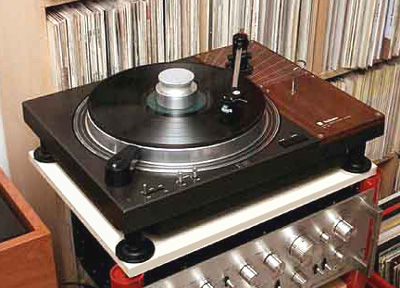
|
SL-110 / SL-1100 Turntables
which worked along the same principle were introduced: SL-1100 (motor
deck plus EPA 110 arm), SL-110 (without tonearm), and SL-150 (without
tonearm). |
 |
TECHNICS CATALOG LP A tool in the clever marketing by Matsushita/Technics/ Panasonic of their direct drive turntables was the release of a special Technics Demonstration Lp in a gatefold cover picturing the range of DD turntables: SP-10Mk2 (SL1000), SL-1100, SL-1200, 1300, 1400, 1500, 1800, etc. At left the Dutch edition. I am not sure if this was a typical Dutch affair. |
Technics SP-10 Mk2
|
|
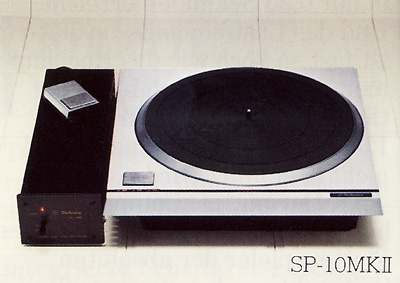
SP-10 Mk 2 In 1975 the SP-10 Mk2 (together with its Power Supply SH-10E) was introduced. It was a great step forward if compared to the technique of the Mk1 and other DD-turntables. The functioning of the Mk2 was quite different. Now -to put it simply- the motor was turning at a given speed which was steered by a set frequency which was generated by a quartz crystal. Hence the turntable's performance is not affected by any altering in the frequency of the mains nor any voltage fluctuation. A fluctuation in speed is instantly corrected by the motor itself without the use of a tachometer or a playback head which reads the magnetic imprints on the inside of the platter (a method Denon used in their DD turntables). This meant a mere perfect performance as far as speed accuracy, wow and flutter are concerned. In order to avoid fluctuations from temperature and those caused by mechanical parts no speed adjustment facility (variable pitch) was incorporated. This was a drawback for people with perfect pitch and for those music lovers who wanted to play a variety of old shellac records which are not always cut at 78 RPM. A new and unique feature of the SP 10 MkII was the incorporation of a mechanical and electronic brake not encountered on other DD turntables, not even the SP10MKI. It reminded of the direct start of the EMT turntables and the clutch of the Thorens TD-124 and it made the SP-10 Mk2 a true Studio Turntable. Many radio stations installed the Mk2 for playing 33.33 and 45 rpm discs for the broadcast of music programs. By increasing
the capabilities of the motor and designing refined and complex electronics
to regulate the motor's rotation (for smoothing out the shocks when moving
from one pole to the next) the SP10mk2 attained its practically incomparable
specifications. Instead of the soft mat which was used on the earliest SP10 (SL1000) and SL110, now a hard mat adorned the heavy platter. The hardness is not without significance for the sound performance which is an essential feature of the SP10Mk2. It goes without saying that an Mk2 or Mk3 is practically worthless without the appropriate power supply (SH-10E). A power supply is hard to find separately. And if only the motor is offered in an auction you will never be sure to find a separate power supply unit (PSU) and you will not be able to play records with your SP 10. For an expert it would be possible to build a power supply as in the Service Manual all circuits and values of components are given. The platter
of the SP-10 mkii weighs 2.9 kg / 6.4 lb. To prevent a turntable platter
from sounding like a bell, the inside has to be covered with a sound absorbing
material. This can be a layer of a resin like substance as with the early
Melco turntables or - as in the case of the Technics SP 10 mkii - with
a relatively thick bituminous sheet. Of course not in the middle part
which is connected to the motor section. |
  |
SHIPPING BRACKET Note: If the motor unit of an SP10, SP10mk2 or SP10Mk3 is being transported, instructions in the owner's manual have to be followed carefully. In case of the Mk2, the motor has to be secured with the original metal clamp which should be fixed with three screws to the disc of the motor and with four screws to the chassis. This in order to avoid damage caused by shock. If the clamp is not available, a clamp should be borrowed or made by you. The omission of a clamp can damage the motor and the spindle and impair its accuracy. Many prospective buyers and also owners of the SP10Mk2 have asked for details of the special clamp which is necessary if the turntable has to be transported. If your SP-10Mkii does not have this clamp, you can make this shipping bracket yourself or have it made in a machine shop. It is a simple piece cut out of a thin sheet of metal. Aluminum of 2 mm thickness will be OK also. Thinner sheets may bend though. The template can be ordered. See at the end of this page. |
 |
ORIGINAL SCREWS OF MK2 In some cases the original screws of an SP-10 MKii are lost and have been replaced. At left the original screws. The fixed, brass cylinders take care of precise positioning of the platter. No deviation is allowed. |
 |
SP-10 Mk2 CLOSED MOTOR The MkII has a completely closed motor, similar to the SL110. The relatively large disc which is the top of the motor supports the platter. In addition to the electronic brake there is an adjustable belt which helps break the motor/platter combination mechanically. Belt and the adjustment facility are hidden under a plate which surrounds the motor/disc so dust is kept out. |
 |
INDEPENDENT MOTOR The motor of the SP-10 MkII is a complete unit which in principle can be used for any platter which is not too heavy and has the holes to be fixed on top of the motor. Constructing direct drive turntables this way was the custom in the 1970's. |
The Competition - Sony, Denon, Kenwood
 |
KENWOOD L-07 Kenwood (Trio in Great Britain) manufactured quality turntables likes the KD 500, 550 and 650. Undoubtedly inspired by the vast success of the Technics DD turntable series, they designed a high quality direct drive turntable along with a series of electronics. This was Kenwsood's answer: L-07D, with a powerful motor and electronics, weighing 35 kg. in total, with a periphery ring and turntable weight added. There are many Kenwood aficionados who find their peers via the Unofficial Kenwood Web Site. |
 |
SONY PS-X9 There are other high quality direct drive turntables: Denon DP-65, 75 and 80 are well known. Denon and also Sony came up with specific studio turntables: PS-X9 and DP-100M respectively. These are complete systems, tone arm included. Not only the price but surely the design may have been the reason that the DP-100M and the PS-X9 were less popular among audiophiles and serious music lovers who like to add a tone arm of their choice. |
|
|
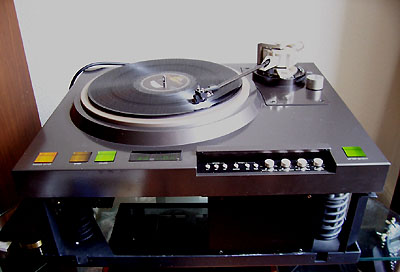
DENON - NIPPON COLUMBIA - DP-100M While
the Technics SP-10 and the Denon DP-65, 75 and 80, can be mounted on
any sort of plinth and can be combined with a variety of tone arms,
the Kenwood came with its own arm and there was a possibility to mount
a second arm. Although the Technics SP-10mk2 and Mk3 are considered
as studio turntables, Nevertheless audio magazine 'La Nouvelle Revue
de Son' in France awarded the DP-100M their "Decibel of Honor"
(Décibel D'Honneur). |
 |
 |
|
The Denon DP-100M uses a split platter to minimize rumble. The rumble value is -90 dB which is an credible achievement. It is not advised to use a different turntable mat on the DP-100 (if this would be possible at all), as a different mat will influence the signal to noise ratio in a negative way. A spindle weight can of course be used. |
The DP-100 boast of a very strong and heavy motor which is used in quality cutting lathes. Wow and flutter is also excellent: 0.003 %. The heavy chassis and motor rest on appropriate springs in order to isolate the chassis and platter from the environment: mechanical feedback is practically non existent. |
 |
 |
|
When taking off the top platter, the basic platter is revealed. The two holes are there to lift this basic platter from the spindle. The basic platter is designed in such a way that there is a second rim underneath which has a fine magnetic pattern on the inside |
The magnetic pattern on the inside of the platter is read by a recording head as used in tape recorders. The recorded signal is compared instantly with the frequency of the quartz crystal in the electronic circuitry for steering the motor. The smallest deviation is recorded and corrected. |
|
|
|

Technics SP-10 Mk3 - SL 1000 Mk3
|
|
SP 10 Mk III Technics went even a step further in designing the perfect turntable. In 1981 the SP-10 Mk 3 was introduced. It had a platter consisting of a copper alloy inner section and an aluminum outer part, weighing a mere 10 kg = 22 lb. and the complex electronic circuitry to regulate the speeds and constancy of the rotation of this heavy platter. The total unit itself weighs 18 kg (=40 lb.). This machine was not sold in great quantities because digital media were emerging on the horizon and few owners of an SP-10 mk2 saw the need of switching to this newer version of turntable. In hindsight they may regret it. VARIABLE SPEED The advantage
of the Mk3 is not only the practically unmeasurable wow and flutter, but
the fact that now all speeds can be adjusted in 0.1% steps to +/-9 % which
makes this unit ideal, also for transfers of all records including all
sorts of shellac records. Note: if you look carefully you can see that
the SP-10 Mk3 has a softer turntable mat (at least in the picture) compared
to the mat on the SP10Mk2 which is harder. PRICES Stereo Buyers' Guide from 1989 still lists both SP-10mk2 and Mk3 turntables. Prices were then:
|
||||||||
 |
OPEN MOTOR The newer generation of Technics turntables introduced at the end of the nineteen seventies/beginning of the nineteen eighties do no longer have a closed motor compartment. Now the stator with the green coils (core) is solid with the plinth/chassis. The bearing housing of the spindle is fixed in the center. The supporting disc on top of the spindle is actually very small. This "simpler" method of construction was applied in the Technics SP-10Mk3 design and later found in the cheaper models like SL 1810 and SL 1310, the 10 referring to the SP-10. |
||||||||
 |
HEAVY PLATTER At left the underside of the heavy platter. Much of the weight is of the large ring with magnets: the rotor. The mass is not concentrated at the periphery of the platter as would be the case with heavy belt drive designs. Not in the SP-10 Mk3 because that would slow the starting and stopping time of the platter. It is obvious that care has to be taken to prevent dust to settle in the stator and rotor. Check and clean with compressed air from a can (Dust-Off) or use a hair blower set to cold. Then you can put the platter back again. The turntable has a starting torque of 16 kg/cm-2, nearly three times the value of the SP-10 mk2. The rotor and stator of the SL 1810 (shown below) are of course less sturdy and quite small if compared to the large and heavy rotor and stator of the magnificent SP-10 Mkiii. The electronics of the simpler turntable match of course this small motor with light platter and do not differ much from the design of the later SP-15 and SP-25. |
||||||||
 |
 |
||||||||
 |
WARNING Since the platter is part of the motor, all 10-models do carry an important warning. At left the one on the SL-1810 turntable. 1. The turntable platter of this set is part of the motor assembly. Therefore do not remove the turntable platter unnecessarily. 2. Do not connect the AC power plug when the turntable platter is removed. This may cause power supply problems. 3. Never let dusts or iron fillings come in contact with the rotor magnet. 4. If lubrication becomes necessary after approximately 2,000 hours of playing, remove the turntable platter and apply 2 or 3 drops of the enclosed special oil to the top of the bearing. |
||||||||
 |
HANDLE WITH CARE The platter
of the Mk3 consists of an aluminum base topped by a copper platter. The
aluminum platter connects directly to the spindle. |
||||||||
 |
You need two handles for carefully lifting the heavy platter. Pictures
of the Mk3, rotor, stator and platter with handles courtesy photographer
and audio enthusiast. |
Obsidian Base, Tonearms, SP-15, Balance Scale
|
|
VOLCANIC GLASS The technicians of Technics designed a special base for the SP10 mk2 which was also used for the SP10 mk3. It was made of obsidian (volcanic glass) which had a nice shape and was beautifully polished. Hi-Fi Choice from Great Britain however reported that the bass was somewhat slender and that there was some shallowness in the mid and upper mid frequency region. This is certainly caused by the amorphous "structure" of volcanic glass. Glass sometimes used for plinths and platters has this characteristic.
|
 |
EPA 100: OIL DAMPED TITANIUM TONE ARM They also designed a special arm to match the new SP10MkII by using a very innovative damping mechanism with an oil reservoir inside its counterweight, and by applying the then new space age material titanium: EPA 100 (1976). The titanium arm tube and the damping of the resonance by means of an oil reservoir in the counter weight made the signal very precise and clean. Also the head shell contributed to that much controlled signal. The arm is intended to be used with relative low compliance phono cartridges. The sound with the EPA 100 is somewhat less chiseled and vigorous, but rather dull, if a high compliance cartridge is mounted. |
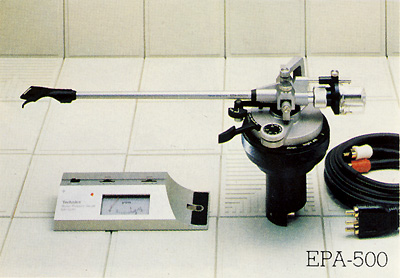 |
EPA 500: INTERCHANGEABLE WANDS Technics
introduced a tone arm with an even more revolutionary design: EPA 500
(1979) with various arm tubes for use of a variety of cartridges from
low to extremely high compliance. The arm consist of the base EPA B 500
and the arm unit EPA-A501H. |
 |
ADAPTATIONS Instead of the A501H other arm tubes can be inserted: A501M and A501L with more mass, for medium complaince and low compliance cartridges respectively. |
 |
Technics EPA-100P Tonearm Japanese brochures often show images of the black version of the EPA-100 tonearm. There is yet another black version of the EPA-100 and that is the EPA-100P. It is a tonearm specifically made for broadcasting sound studios and radio stations where a more sturdy use of the equipment is inevitable. Thomas Kiefer from Germany wrote about this tonearm to me. The EPA-100-P has no facility to adjust VTA. The arm in his possession does not have a lift either. But the image he sent me of the total broadcast SP-10Mk2 shows that the arm support is obviously lowered and raised by means of the switch at right in the front of the plinth. Furthermore it has a safety bracket so the arm cannot sway and drop when accidentally touched. |
|
|
More Differences At left is another image he sent me. He says that the mounting hole is larger than that of the original EPA 100. The counterweight (which is not oil damped) comes in two versions, a heavy one and a lighter one. These should obviously be chosen in relation to the cartridge used. The heavier weight is meant for heavy cartridges like those of Fidelity Research and the old Ortofons. The lighter weight is to be used with common cartridges weighing more or less 10 gr. The Antiskating range is adjustable by turning a knob. The highest indication on the scale is 4 which means that also mono cartridges playing with a relative substantial down force can be used. On the common EPA-100 there are two horizontal bearings (red rubies). They can be spotted on the sides. On the EPA-100P however these are metal bearings as far as can be seen. Thomas Kiefer did send these four images. Anyone who has information and/or specifications is invited to take action and help out: Click to send an email. |
 |
|
 |
SP-15 The EPA-500 was initially intended for the SP-15 turntable which has the values for accuracy of speed, rumble, wow and flutter of the SP-10 MkII. However the motor was less powerful, 11 Watt for the SP-15 and SP-25, and 26 Watt for the SP-10 Mk2. But the SP-15 and 25 have the possibility to adjust the three individual speeds by a margin of +/- 9.9% like the SP-10 Mk3. The deck includes the electronics which are hidden by a circular cover. The unit easily fits the SH-15B1 base. And it should be no problem to construct a DIY base with the appropriate circular hole. |
 |
SH-50-P1 The SH-50-P1 is a beautiful analog scale for measuring the down force from 0.5 gr. to 3 gr. Modern digital scales are of course more accurate in displaying the values. But when using this electronic scale a while, it is easy to know what the positions between the markings mean. Though the user should be born with a carpenter's eye. |
The Quest for a Solid Plinth
|
|
Because of the high torque the platter of both SP10mkII and mkIII starts within a fraction of a second. There is an electronic and mechanical stop. When the platter is not spinning it is mechanically locked, hence the SP10 is not suitable for scratching even if the mechanical brake has been disabled (which can be done). The time of mechanical braking (the speed) can be adjusted to one's own needs. If you want to use this quick start and stop capabilities while the diamond tip is in the groove, a heavy base is imperative. If you do not own the obsidian base you will have to construct a solid and relatively heavy base and decouple it from its environment by means of insulating rubber feet. Various materials can be used for the base:
Better
not use corian as it has a frequency curve with emphasis on high frequencies.
The properties of corian are also not always as desired because the percentages
of aluminum varies. |
 |
A SOLID BASE There are
many solutions on how to build a plinth for the SP-10Mk2 and Mk3. You
can find several proposals with drawings and pictures on the www.
|
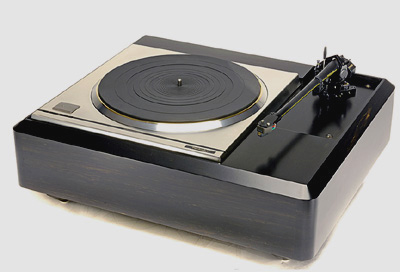 |
SP-10 MK3 At left the new base Albert Porter made for the Technics SP-10 Mk3 which he acquired. This time other kinds of wood were used. He also made a larger base plate for the SME 312S magnesium arm. But the principle of a solid base and the incorporation of a rod to minimize motor noise remained. You can see
more pictures and read about Albert Porter's base for the Mk2 and Mk3
on the |
The Idea of Mitch Cotter
  |
In his audiophile high-end magazine, 'The Audio Critic' (1979), Peter Aczel and his staff rightfully warned against the use of the Technics obsidian base and any other heavy base on rubber feet if one wants to listen to music at high sound levels via big loudspeaker systems. The rubber feet do not decouple the heavy base from its surrounding sufficiently, although the fundamental resonance of the complete system is 5 Hz. according to Hi-Fi Choice No. 12 from 1978. Because
of the combination of volcanic glass and the titanium arm with the specific
Technics headshell will give some "shyness" in the low bass.
On top of that volcanic glass, like any kind of glass, is an amorphous
material. It has practically no structure and this somewhat smoothes out
fundamentals and harmonics. Glass should be used for esthetic reasons
only. Not for the best sound! That is why different wooden
bases have been constructed. A famous one was designed by Mr. Kaneta from
Japan. |
 |
Peter Aczel tested the Technics SP-10 Mk2 on the special base made by Mitchell A. Cotter, in short Mitch Cotter. The Audio Critic advised the use of this special base (B1) specifically for the Technics SP10 (and also for the Denon DP6000). In 1980 the German high-end magazine 'HIFI exklusiv' reviewed the Cotter B1-Base, in this case with the Denon player and Fidelity Research tonearm. The staff measured the acoustic breakthrough and the mechanical resonances and compared these to other high-end turntables (Platine Verdier, Win SDC 10, Marantz TT1000). 'HIFI exklusiv' also compared the sonic qualities to the Marantz TT1000. Cotter's modifications of the player and the base he designed was the winner of the lot on all points. |
 |
Mitch Cotter strips the unit and mounts it on a sandwiched baseplate of about 30 mm. It consists of several layers of plastic and steel (the ratio being about 4 mm to 6 mm). The unit should be level at all times. This can be achieved by adjusting the springs by means of inserting small pieces of the same sort of plastic used in the baseplate, but much thinner (1 to 2 mm). |
 |
The springs are heavily damped with plastic foam (at left in the picture). The original electronics are incorporated in the base. |
Suspension without Dismounting
|
|
If you are - like I am - a lover of classical music and jazz and like to play at very realistic sound levels through relatively big loudspeaker systems connected to quality amplifiers, then you need to eliminate mechanical and acoustic feedback. In that case you should build a different plinth in which you use springs instead of rubber feet and decouple the SP10mk2 from its surrounding to the max.
I let myself be inspired by Cotter's design, though the article did not give too much insight into the details of the construction. So I did not strip the turntable as Mitch Cotter did, but kept it intact and made my own design for a base. I also did not use the special layered base plate but two layers of chipboard glued together.
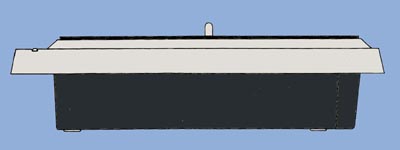
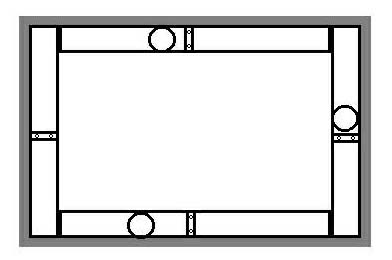
The base plate rests on 3 springs. The positions of the springs can be determined empirically by shifting the positions in relation to the total weight of the base plate with motor unit. My construction makes it easy to lift the rectangular box (side panels) in order to position the springs and find the best position in relation to the weight, to adjust the height of the springs, to determine the damping of the springs and to connect a cable to the tonearm.
The box is not fixed to any part but rests on top of the beams fixed to the bottom plate. For the mounting of the arm I used a sandwiched board of acrylic 4 mm thick covered on both sides with 1 mm thick aluminum.
In my construction the base plate's measurements are: 58 cm (W) x 44 cm (D). Two 18 mm chipboard panels with a black veneer coating (plastic) are glued together.
The bottom of the construction consists again of 2 layers of chipboard, but now the plain kind.
On the 4 sides I have glued (and screwed from underneath) 4 pieces of wood of 4 x 7 cm. They are positioned at a distance of 10 mm from the periphery of the bottom plate.
On the inside of the side panels I have glued 4 pieces of wood of 10 mm x 10 mm at such a height that they will rest on the 2 layers of chipboard and disguise the bottom.
The measurements of the bottom plate are 60 cm (W) x 54 cm (D). Height of the box (side panels) depends on the height of the springs used when they are pressed down by the weight of the unit on its base plate (including the weight of the platter and arm).
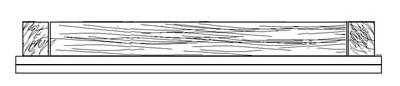
In
the drawing below the amount
of foam to be inserted inside |
|
|
I
can supply the following manuals and the template for the SP10 |
Manual and Template
|
|
|
|
 |
|
© Rudolf A. Bruil - Page created and first published March, 2002 Home
| Audio & Music Bulletin | LP
List | Record Cleaning Service
| 25 Years CD - Digital Audio Compact Disc The Remington Site | Links | Webmaster | Ortofon/Decca/Tannoy Cartridges |
|
 If
a seller of vintage turntables makes a reference to this page in a listing
on eBay or on another site, it does not automatically imply that I endorse
this seller's business or the item he offers.
If
a seller of vintage turntables makes a reference to this page in a listing
on eBay or on another site, it does not automatically imply that I endorse
this seller's business or the item he offers.






 The
result can be extraordinary. The sound is that of a belt driven turntable
with a floating subchassis, but has the high accuracy of one of the
best direct drive motors ever made. The accuracy depends a great deal
on finding the right springs and make them stiff enough by inserting
foam otherwise the turntable does not show the precision it should
have. I have not tried using spikes but that could probably also be
an alternative to just rubber feet with a large contact surface. If
you use a special
The
result can be extraordinary. The sound is that of a belt driven turntable
with a floating subchassis, but has the high accuracy of one of the
best direct drive motors ever made. The accuracy depends a great deal
on finding the right springs and make them stiff enough by inserting
foam otherwise the turntable does not show the precision it should
have. I have not tried using spikes but that could probably also be
an alternative to just rubber feet with a large contact surface. If
you use a special 

